The pre-container compliance walkthrough
The pallet is almost never what holds a container. It is a length of untreated timber somebody used at four in the afternoon to brace a shifting load, and it is on nobody's list.
Everything solid and wooden in the container, not just the pallet
Send us your packaging documentation
We will review the wood-packaging side of an export shipment at no charge and tell you plainly what would be refused. It takes us ten minutes and saves whole weeks.
- Commonest hold cause
- Untreated dunnage
- Second commonest
- Repair after marking
- Travelling certificate
- None exists
- Treatment cycle
- 4–9 hours
ISPM-15 was designed to be enforced by a person looking at a container, not by a person reading a file. Everything difficult about it follows from that.
First: there is no certificate
The mark is the certificate. The standard defines no document that travels with the shipment, which is why nobody can produce an official ISPM-15 certificate for a pallet — and why a supplier offering you an impressive-looking one has produced a document of its own invention. Truthful, possibly. Official, no.
What a forwarder actually wants, when they ask for a certificate, is one of two things: a signed treatment statement naming the order, lot, facility number and dates, or a copy of the chart-recorder trace for the run. We issue both on request at no charge, and the trace is the better one because it is primary evidence rather than an assertion.
Second: list every piece of solid wood in the container
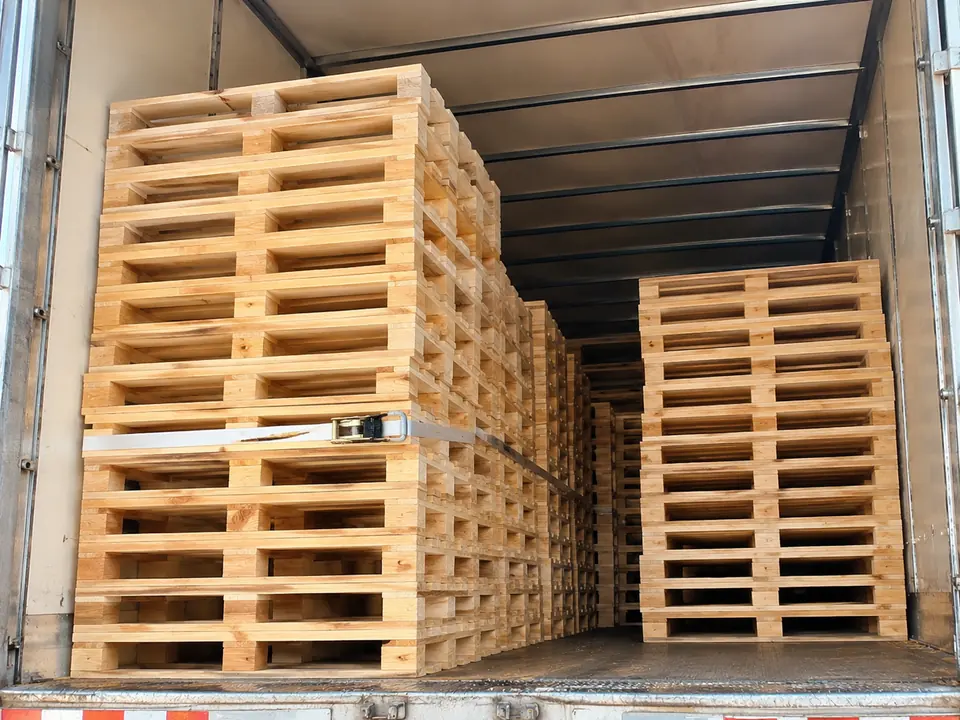
Not the pallets. Everything. Pallets, crates, cases, knock-down panels, skids, bearers, collars, lids, caps, reels and spools — and dunnage, blocking and bracing, which is the category that causes most holds because it is the category nobody writes down.
Plywood, OSB and particleboard are exempt, because their manufacturing process already destroys pests. So is wood six millimetres thick or less, and sawdust, shavings and wood wool. Wine and spirit barrels have a specific exemption. Everything else in that container is regulated.
Third: the bracing rule
Fourth: read the mark in four seconds
- Is the IPPC wheat symbol there and legible? No symbol, no compliance, whatever else the stamp says.
- Is the treatment code HT or DH rather than MB? Several destinations now refuse methyl bromide outright and the rest are heading that way.
- Is it on two opposite sides, readable without moving the load? A mark obscured by a shipping label can fail inspection even when the treatment was genuine.
- Is there fresh repair next to a weathered stamp? Bright board faces, clean saw ends and shiny nail heads under an old mark is the one that strands containers.
Fifth: understand the repair trap
ISPM-15 applies to the wood packaging material as a whole, not to the pallet as a registered object. When a yard replaces a deck board with untreated wood, the unit now contains untreated wood under a mark certifying the opposite. The stamp did not become wrong; the pallet did. The correct handling is to re-treat and re-mark the whole unit. The common handling, at yards that do not care, is to leave the old mark alone because it still looks fine.
This is invisible to a buyer by design. The only defences are buying from a registered facility that treats its own wood, and asking the question in writing: do you re-treat and re-mark after a repair that introduces untreated wood? If the answer involves the word “usually”, assume no.
Sixth: build the cycle into the schedule
A heat treatment run is four to nine hours end to end: load and probe, ramp, a thirty-minute hold that only starts when the slowest probe reaches 56 °C, a soak margin, cooling, then marking. Twenty-four hours from arrival is routine. Same morning is not, and wet or cold stock lengthens the ramp considerably because water absorbs a great deal of energy changing phase.
Seventh: check the destination, not the standard
ISPM-15 is the floor. National measures sit on top of it and they vary: debarked wood is required for some destinations, additional declarations for others, and inspection intensity differs enormously between regions. Confirm the current requirements with your forwarder before loading rather than after, and keep the treatment statement and trace in the shipment file where they will never be requested in the ninety-nine shipments that go well.
We needed six hundred heat-treated units with a border crossing in four days. The stamps were dry before our broker finished the paperwork.
Compliance appendix
ISPM-15 in full, plus the repair interaction that causes most border holds.
- Standard
- ISPM-15, issued under the International Plant Protection Convention. Applies to solid-wood packaging crossing most national borders.
- Heat treatment (HT)
- The core of the thickest member must reach 56 °C and hold it for 30 continuous minutes. Surface temperature is irrelevant; chamber time is not the measure.
- Dielectric (DH)
- An alternative route: 60 °C for one minute throughout the profile. Used for thinner material.
- The mark
- IPPC wheat symbol, two-letter country code (US), the facility's registration number, and the treatment code. On at least two opposite sides, legible without moving the load.
- No certificate exists
- The mark is the certificate — the standard defines no travelling document. We issue a voluntary treatment statement and the chart-recorder trace on request.
- Regulated
- Pallets, crates, cases, skids, bearers, dunnage, blocking and bracing, collars, lids, reels. The dunnage category causes most holds.
- Not regulated
- Plywood, OSB and particleboard; wood 6 mm thick or less; sawdust, shavings and wood wool; wine and spirit barrels.
- After repair
- A stamped unit repaired with untreated wood carries a false mark. It must be re-treated and re-marked. This is the commonest compliance failure in recycled stock.
- What we refuse
- Methyl bromide fumigation, and applying a mark to wood we did not treat — for anybody, at any price, for any deadline.
What a repair does to a mark
| Repair | What it is | Bench time | Effect on grade |
|---|---|---|---|
| Board swap | Cracked deck board out, sound reclaimed board of equal thickness in | 60–90 sec | A → B |
| Companion board | A second board nailed alongside a cracked original | 45 sec | A → B |
| Stringer plug | Cracked stringer section cut out, matching plug let in and double-nailed | 3–5 min | A → B |
| Metal plate | Galvanised plate across a stringer crack | 45 sec | A → B, disclosed |
| Full re-nail | Every fastener on the unit driven or replaced | 90–120 sec | No change — standard on anything apart |
| Trim / cut-down | Oversized unit sawn to a smaller footprint, cut edge re-nailed and chamfered | 4–8 min | Becomes a custom unit |
| Re-stamp | ISPM-15 mark re-applied after re-treatment | — | No change |
| Condemn & harvest | Sound boards to the repair bench, remainder to fiber | 2 min | — |
We never plate a stringer and call it Grade A, and never hide a companion board under a label. The four checks at the bench, in order: stringers sound? how many deck boards gone? end-grain separation? is the footprint worth the labour?
Moisture, treatment and the difference
| Moisture content | What happens | Typical source | Freight weight |
|---|---|---|---|
| 6–12% | Indoor equilibrium. No mould risk. Dimensionally stable. | Kiln dried, stored inside | Lightest |
| 12–19% | Safe working range — our standard ceiling. | Covered dry stack | Normal |
| 19–25% | Mould within days to weeks in warm conditions. | Rain-exposed stacks, green lumber | +5–10% |
| 25–40% | Mould rapid, blue stain likely. | Pallets left in the open through a wet week | +10–20% |
| Above 40% | Saturated. You are paying freight on water. | Standing water, flooded yard | +20%+ |
Mould needs free water. Below roughly 19% the water in wood is chemically bound in the cell walls and spores cannot germinate; above it, they can. Heat treatment kills insects and confers no moisture guarantee; kiln drying reduces moisture and is not a phytosanitary treatment. They are separate claims and conflating them causes both mould claims and border holds.
Export appendix
Destination notes, loading patterns and the bracing rule that removes the commonest border hold there is.
Destination notes
| Destination region | ISPM-15 | Notable additional measures | Practical advice |
|---|---|---|---|
| European Union / UK | Required | Debarked wood required; strict on dunnage | Debark, treat, mark two sides, and audit your bracing |
| China | Required | Documentation scrutiny; MB increasingly unwelcome | Heat treatment only; keep the chart trace in the file |
| Australia / New Zealand | Required | Among the strictest inspection regimes anywhere | Expect inspection; immaculate marks and no bark |
| Canada / Mexico | Required between NAFTA-region states for most wood | Land crossings inspect quickly and unsentimentally | Treat and mark everything, including the skid under an awkward item |
| Brazil / Mercosur | Required | Marking legibility enforced | Two opposite sides, nothing obscured by labels |
| Japan / South Korea | Required | Fumigation records examined closely | Heat treatment removes the question |
| Middle East / Gulf | Required | Variable national measures | Check per country before loading, not after |
| India | Required | Additional declarations in some states | Confirm with your forwarder in advance |
| Within the United States | Not required | — | Treatment only matters for onward export |
Indicative only, and national measures change. Confirm the destination's current requirements with your forwarder before loading — we will review the packaging side of your documentation at no charge if you send it to us.
Trailer loading patterns
| Pattern | How it loads | Positions in a 53' van | Trade-off |
|---|---|---|---|
| Straight / square | Pallets squared to the trailer walls, two across | 26 | Simplest, fastest, most stable. The default |
| Turned (rotated 90°) | Pallets turned so the 48" face runs across | 24–26 | Fits some footprints better; check racking orientation at the far end |
| Pinwheel | Alternating orientation in each row | 24–26 | Fills awkward widths; slower to load and harder to brace |
| Chimney / centre gap | Deliberate void down the middle | 22–24 | Air movement for produce; loses positions |
| Double stack | Two tiers where product and height allow | up to 52 | Doubles capacity; needs a cap or a strong top layer |
| Floor loaded (no pallets) | Cases hand-stacked | n/a | Maximum cube, maximum labour, and the reason pallets were invented |
Positions assume 48×40 units. Bracing matters more than pattern: void fillers and marked, treated bracing timber prevent the shifting that incline-impact testing is designed to simulate.
Dunnage and bracing
- Void fill
- Airbags, honeycomb panels or marked bracing timber. Any solid wood used is regulated under ISPM-15 exactly like the pallet.
- Bracing timber
- Keep a bundle of pre-treated, IPPC-marked 2×4 at the dock and make it the only wood permitted into a container. This single rule removes the commonest border hold there is.
- Load bars and straps
- Not regulated, and not a substitute for bracing on a shifting load.
- Corner boards
- Reclaimed block stock protects strapped corners and adds vertical crush strength. Cheap, and routinely omitted.
- Slip sheets
- Not solid wood, so outside ISPM-15 entirely — a real advantage on export lanes, offset by needing a push-pull attachment at both ends.
- Top caps
- Rigid hardwood caps distribute a stacked load across collar walls rather than into the product below.
- Loading checklist line
- “All solid wood in this container is ISPM-15 marked”, signed by the loader. One line, and it changes behaviour.