Zero to landfill
The claim is simple and the proof is tedious: every pound of wood that enters this yard leaves as a product, and a third party checks the scales four times a year.
Ask for a diversion statement
Twelve seconds of typing beats a week of phone tag. Everything you send lands with a coordinator who knows the yard inventory.
- Landfill rate
- 0.0% since 2016
- Audit
- Quarterly, third party
- Streams tracked
- 7
- Records kept
- 7 years
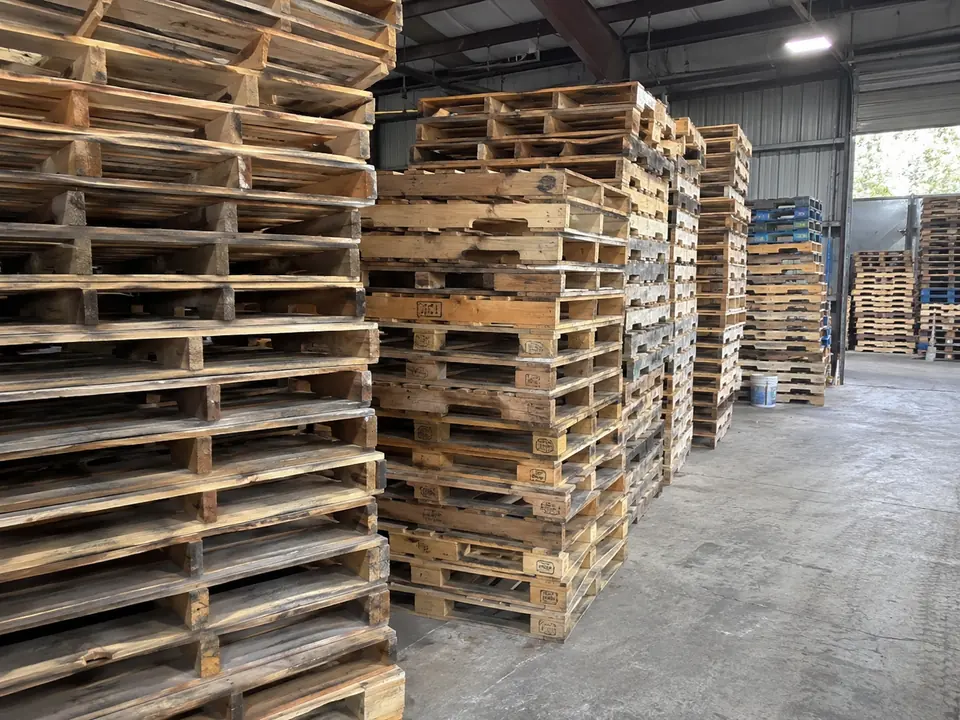
Anybody can say zero. The question is what happens to the awkward pound — the painted board, the oily dunnage, the unidentifiable chunk.
The seven streams
| Stream | Destination | Share of mass | Verified by |
|---|---|---|---|
| Reusable whole | Grading and resale | 71% | Unit counts + weighbridge |
| Repairable | Repair benches | 20% | Bench lot records |
| Board harvest | Repair stock | 3% | Internal transfer tickets |
| Remanufacture | Cut-down units, crates, collars | 2% | Shop records |
| Material grind | Mulch, bedding, path fiber | 3% | Grind batch weights |
| Industrial fuel | Regional boiler | 1% | Outbound scale tickets |
| Metal | Scrap recycler | <1% | Scrap receipts |
Shares are a 2025 average by mass. Landfill does not appear because it has no row.
How the awkward pound is handled
Painted or coated wood
Segregated at intake, never ground for mulch or bedding, routed to permitted industrial fuel only. If a load is too contaminated even for that, we refuse the load rather than bury it.
Oil-contaminated dunnage
Refused at the gate. We tell the customer why and point them to a hazardous-waste handler. Taking it would make our claim false.
Engineered panel
Plywood, OSB and particleboard are refused — resins foul both the grinder and the fuel spec.
Metal
Nails, plates, staples and banding separate magnetically and go to a scrap recycler by weight.
Fines and dust
Screened fines go to animal bedding and erosion control blankets rather than to a dumpster.
What you get monthly
- Tonnage received from your sites, by weighbridge ticket.
- Tonnage returned to service as pallets, with unit counts.
- Tonnage into each material stream.
- Tonnage to industrial fuel, stated separately — we never call energy recovery 'recycling'.
- Landfill tonnage: zero, with the auditor's most recent confirmation date.
- Net CO₂e avoided for the period, using the published ledger method.
Their statement was the only supplier document our auditor accepted without a follow-up question. That is a rare sentence in my job.
Evidence appendix
The arithmetic and the audit trail, in full. Every figure here is rounded down on purpose — a sustainability claim that cannot survive scrutiny is worse than no claim at all.
Where every pound of intake goes
| Stream | Destination | Share of intake mass | Verified by |
|---|---|---|---|
| Reusable whole | Grading and resale | 71% | Unit counts + weighbridge |
| Repairable | Repair benches | 20% | Bench lot records |
| Board harvest | Repair stock for other units | 3% | Internal transfer tickets |
| Remanufacture | Cut-downs, crate components, collar panels, furniture | 2% | Shop records |
| Material grind | Mulch, bedding, path and arena fiber | 3% | Grind batch weights |
| Industrial fuel | Regional boiler — never called recycling | 1% | Outbound scale tickets |
| Metal | Scrap recycler by weight | <1% | Scrap receipts |
| Landfill | — | 0.0% | Quarterly third-party audit since 2016 |
2025 averages by mass. Landfill has no row because it has no tonnage. Part of how that stays true is refusing material we cannot route: painted, stained or pressure-treated lumber, engineered panel, and anything contaminated with food residue, chemicals or hydrocarbons.
The carbon ledger method
| Quantity | Figure | What it covers | Why it is conservative |
|---|---|---|---|
| Avoided emissions per reuse | 1.62 kg CO₂e | Lumber production, milling and assembly of the new-build pallet not manufactured | Excludes avoided landfill methane and avoided transport of new stock |
| Net of our own operations | ≈1.4 kg CO₂e | After grinder, chambers, forklifts and fleet diesel | This is the figure we will put in writing |
| Lumber kept in service | 32 board feet | A standard GMA 48×40 unit | Measured at the low end of observed board thickness |
| Trips added per repair cycle | 5–7 | Useful journeys gained by repairing rather than replacing | Our fleet data shows 6.8 average; we publish 5 |
| Diverted mass | 35 lb per unit per cycle | Weight kept out of landfill | Dry weight at 15% MC, not as-received |
| Material recovery at end of life | 96% | Material streams only | Excludes the 1% that becomes industrial fuel |
Deliberately low. We leave out avoided landfill methane (which would roughly double the headline) and in-wood carbon storage, because both are contested in accounting conventions and a claim that cannot survive an auditor is worse than no claim.
What the fiber line produces
| Product | Screen | Feedstock restriction | Goes to | Minimum |
|---|---|---|---|---|
| Landscape mulch | 1"–2" single grind | Pallet wood only; no C&D, no painted, no engineered panel | Municipal and commercial landscaping, residential bulk | 10 cu yd delivered |
| Playground & path fiber | Double grind, fines screened out | HT stock only | Trails, dog parks, riding arenas | 10 cu yd |
| Animal bedding | Fine grind, kiln run, triple screened | HT stock only, segregated at the grinder | Equine and livestock operations | 10 cu yd |
| Arena fiber | Coarse, de-fined | HT stock only | Riding arenas, paddocks | 20 cu yd |
| Boiler biomass | 3" minus hog fuel, moisture declared | Takes the chemically treated and unknown-origin stream | Regional industrial steam and co-generation | By the ton |
Three magnetic separation passes — one after each size change — plus a hand inspection of the finished windrow before anything is loaded. Grinding does not remove steel; it exposes new steel, which is why the magnets come after every stage rather than only at the start. Iron-oxide colourant available on landscape mulch; natural undyed always available and recommended for vegetable beds.
The reuse hierarchy we actually follow
- 01
Gate & segregation
Weighbridge ticket, then sorting by treatment type and origin before anything is cut. Painted, treated or unknown-origin wood is separated here and never enters the mulch or bedding lines. Contaminated material is refused.
- 02
Breakdown & inspection
Units are broken down and inspected board by board. Deck boards are flexed by hand; anything that creaks, splits at a nail hole or shows end-grain separation comes off.
- 03
Stringer judgement
Cracks longer than a third of the stringer depth, or any crack crossing a notch, send the member to the plug bench or condemn it. This single check decides most of the economics.
- 04
Repair & re-nail
Board swap, companion board, plug, plate, trim. Then every fastener on the unit is driven or replaced — the invisible half of the work, and the part cheap yards skip.
- 05
Moisture & square
Pin meter on random units per lot, reading recorded. Diagonals measured; out-of-square beyond ½" is corrected, not shipped. Above 19% MC the load waits in the dry stack or goes through the kiln.
- 06
Grade, stamp & lot
Grade, build date and lot in soy ink on a stringer face, so a disputed load traces back to the bench and shift that built it. Heat treatment and IPPC marking for anything crossing a border.