Pallet supply
Standing weekly orders, spot loads and just-in-time drops synced to your dock. The same grading standard every week, so your line never has to adapt to a surprise.
Set up a supply line
Twelve seconds of typing beats a week of phone tag. Everything you send lands with a coordinator who knows the yard inventory.
- Standing orders
- Weekly or biweekly
- Spot loads
- 2–5 business days
- Full trailer
- 480–560 units (48×40)
- Grading
- Written standard, per account
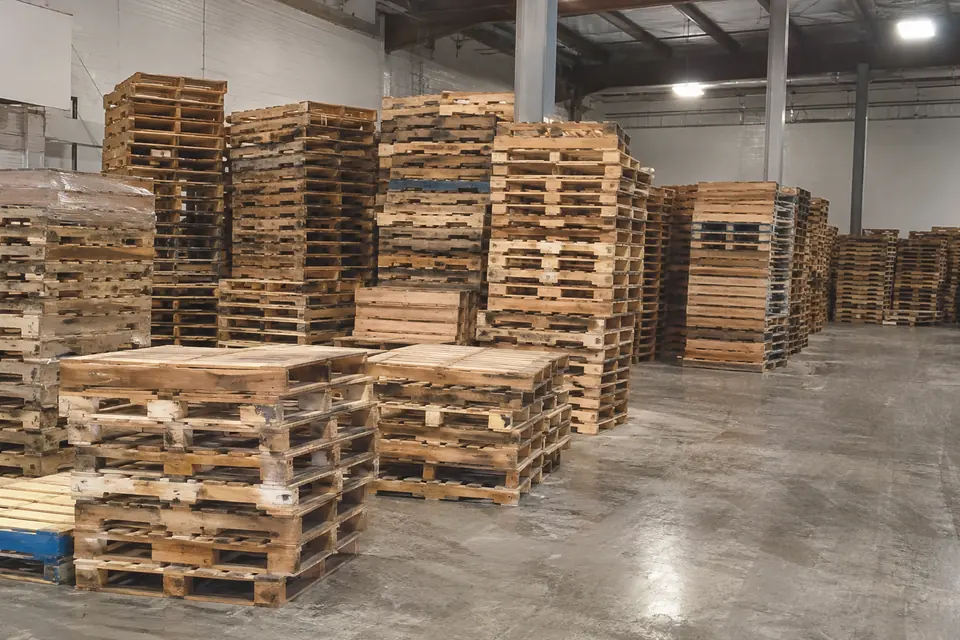
Consistency is the whole product. Anybody can sell you 500 pallets once.
The reason customers stay is not price — it is that the two-hundredth load looks exactly like the first. We hold a written grading standard per account, keyed to your actual line, and the bench works to that document rather than to a general idea of what an A-grade looks like.
Three ways to buy
Standing order
A fixed quantity on a fixed day, priced annually. Cheapest per unit, zero procurement effort, and we hold safety stock on the ground for you.
Spot load
You need 300 units by Thursday. Two to five business days depending on footprint and grade.
Just in time
Drops sequenced to your production schedule, sometimes several times a week, with empties collected on the same visit.
Trailer math, so nobody is surprised
| Footprint | Stacked height | Units per 53' trailer | Typical weight |
|---|---|---|---|
| 48×40 stringer | 15 high | 480–560 | 18,000–24,000 lb |
| 48×40 block | 13 high | 416–468 | 21,000–27,000 lb |
| 48×48 | 14 high | 392–420 | 20,000–26,000 lb |
| 1200×800 EPAL | 15 high | 540–600 | 19,000–25,000 lb |
| Collars (folded) | Banded bundles | 1,100–1,400 | 14,000–18,000 lb |
Counts vary with repair thickness and whether the load is strapped or stacked loose. We confirm the exact count on the BOL.
One written standard per account
Maximum deck gap, minimum board thickness, permitted repairs, stamp requirements, moisture ceiling. We write it down with you once, then grade to it forever.
How grading worksCan you hold inventory for us?
Yes — standing-order accounts get dedicated safety stock on the ground, typically two weeks of cover, at no storage charge.
What happens if a load fails inspection?
Photograph it, email us, and we replace it on the next route plus credit the difference. We do not argue about grading; we fix it and then go find out which bench got it wrong.
Do you deliver outside Texas?
Regularly to Oklahoma and Louisiana on backhaul. Beyond that we will quote it honestly, which sometimes means telling you to buy locally.
Service appendix
Lead times, minimums and the process behind them. Published rather than quoted on request, because a lead time you can plan around is worth more than a lead time that sounds good.
Every service, with its lead time
| Service | Lead time | Minimum | Notes |
|---|---|---|---|
| Paid pallet collection, Austin metro | 48 hours, routed | 100 units or 1 trailer | Counted with your team present, signed on the dock |
| Paid collection, Texas Triangle | Weekly, fixed day | 1 trailer | Backhaul lanes to SA, Houston, DFW |
| Yard drop-off | Open during yard hours | 5 units | Saturday mornings are easiest; no appointment |
| Spot load, common footprint | 2–5 business days | 25 units delivered | Subject to grade availability |
| Standing order | Fixed day each week | By agreement | Annual pricing, ≈2 weeks of safety stock held here |
| Repair, toll (your units) | 3–7 business days | 100 units | Your asset numbers and stamps retained |
| Heat treatment & ISPM-15 stamping | Usually 24 hours | By agreement | 4–9 hour cycle; chart trace filed per lot |
| New build to spec | 5–10 business days | 100 units | Tolerance ±⅛" achievable |
| Cut-down to custom footprint | 3–6 business days | 50 units | Tolerance ±¼" |
| Custom crate, one-off | 3–8 business days | 1 | On-site crating available in Austin metro |
| Custom milling, cut list | 3–6 business days | 1 shop hour | Tolerance ±1/16" dimensional |
| Bulk mulch or bedding | 2–5 business days | 10 cu yd | 60 mile delivery radius |
| Sourcing audit | By arrangement | 500 units/week | Half a day on site; free above that volume |
| Same-day, Austin metro | Same day | By arrangement | Premium rate, when a line is about to stop |
All times Central. Lead times are commitments we take seriously and not guarantees against weather, road closure or equipment failure.
What happens between the gate and the trailer
- 01
Gate & segregation
Weighbridge ticket, then sorting by treatment type and origin before anything is cut. Painted, treated or unknown-origin wood is separated here and never enters the mulch or bedding lines. Contaminated material is refused.
- 02
Breakdown & inspection
Units are broken down and inspected board by board. Deck boards are flexed by hand; anything that creaks, splits at a nail hole or shows end-grain separation comes off.
- 03
Stringer judgement
Cracks longer than a third of the stringer depth, or any crack crossing a notch, send the member to the plug bench or condemn it. This single check decides most of the economics.
- 04
Repair & re-nail
Board swap, companion board, plug, plate, trim. Then every fastener on the unit is driven or replaced — the invisible half of the work, and the part cheap yards skip.
- 05
Moisture & square
Pin meter on random units per lot, reading recorded. Diagonals measured; out-of-square beyond ½" is corrected, not shipped. Above 19% MC the load waits in the dry stack or goes through the kiln.
- 06
Grade, stamp & lot
Grade, build date and lot in soy ink on a stringer face, so a disputed load traces back to the bench and shift that built it. Heat treatment and IPPC marking for anything crossing a border.
The repair vocabulary
| Repair | What it is | Bench time | Effect on grade |
|---|---|---|---|
| Board swap | Cracked deck board out, sound reclaimed board of equal thickness in | 60–90 sec | A → B |
| Companion board | A second board nailed alongside a cracked original | 45 sec | A → B |
| Stringer plug | Cracked stringer section cut out, matching plug let in and double-nailed | 3–5 min | A → B |
| Metal plate | Galvanised plate across a stringer crack | 45 sec | A → B, disclosed |
| Full re-nail | Every fastener on the unit driven or replaced | 90–120 sec | No change — standard on anything apart |
| Trim / cut-down | Oversized unit sawn to a smaller footprint, cut edge re-nailed and chamfered | 4–8 min | Becomes a custom unit |
| Re-stamp | ISPM-15 mark re-applied after re-treatment | — | No change |
| Condemn & harvest | Sound boards to the repair bench, remainder to fiber | 2 min | — |
We never plate a stringer and call it Grade A, and never hide a companion board under a label. The four checks at the bench, in order: stringers sound? how many deck boards gone? end-grain separation? is the footprint worth the labour?
Where every pound goes
| Stream | Destination | Share of intake mass | Verified by |
|---|---|---|---|
| Reusable whole | Grading and resale | 71% | Unit counts + weighbridge |
| Repairable | Repair benches | 20% | Bench lot records |
| Board harvest | Repair stock for other units | 3% | Internal transfer tickets |
| Remanufacture | Cut-downs, crate components, collar panels, furniture | 2% | Shop records |
| Material grind | Mulch, bedding, path and arena fiber | 3% | Grind batch weights |
| Industrial fuel | Regional boiler — never called recycling | 1% | Outbound scale tickets |
| Metal | Scrap recycler by weight | <1% | Scrap receipts |
| Landfill | — | 0.0% | Quarterly third-party audit since 2016 |
2025 averages by mass. Landfill has no row because it has no tonnage. Part of how that stays true is refusing material we cannot route: painted, stained or pressure-treated lumber, engineered panel, and anything contaminated with food residue, chemicals or hydrocarbons.
What drives the price you are quoted
| Cost component | Share of a recycled unit | What moves it |
|---|---|---|
| Labour | 35–45% | Local wages. The largest and stickiest cost. |
| Core acquisition | 20–30% | What we pay warehouses for their empties. The main driver of market swings. |
| Freight | 15–25% | Diesel, driver availability, truckload capacity. Pallets are mostly air. |
| Repair materials | 5–10% | Fasteners; harvested boards cost labour rather than lumber. |
| Yard, plant and compliance | 5–10% | Rent, grinder, chambers, audits, insurance. |
| New lumber | 0% on a recycled unit | Sets the price of a new pallet, which sets a ceiling on recycled by substitution. |
This is why a falling lumber futures chart does not translate into a proportional fall in recycled prices: there is no new lumber in the cost structure. Lumber spikes pull recycled prices up quickly on demand; lumber crashes push them down slowly, because the cost floor is labour and nobody's wages fell.
And when in the year you are quoting it
| Period | Core supply | Demand | Price pressure |
|---|---|---|---|
| January – February | Plentiful — post-holiday backlog clears | Soft | Lowest |
| March – May | Normal | Rising — spring construction and beverage | Firming |
| June – August | Tightening — summer slowdowns, heat limits bench output | High — beverage peak | Firm |
| September – November | Tight — everything is shipping, nothing is sitting still | Peak — pre-holiday build | Highest |
| December | Erratic | Falling fast after mid-month | Falling |
Central Texas pattern. Agricultural regions invert parts of it — harvest demand can make September the tightest month for an entirely different reason. A standing order with annual pricing gives up the January bargain and avoids the September shock, which is a trade most operations should make.
Commercial appendix
The arithmetic behind a pallet decision, the sector matrix, and the four decision trees we walk customers through.
Cost per trip, worked
| Line | One-way recycled | Repaired recycled, 6 trips | New build, 10 trips | Pooled rental |
|---|---|---|---|---|
| Unit cost delivered | $11.50 | $13.00 | $26.00 | $0 capital |
| Useful trips | 1 | 6 | 10 | per trip |
| Cost of the asset per trip | $11.50 | $2.17 | $2.60 | $5.50 issue fee |
| Freight per trip | $1.80 | $1.80 | $1.80 | included |
| Repair share per trip | — | $0.55 | $0.42 | included |
| Handling labour per trip | $0.90 | $0.90 | $0.90 | $0.90 |
| Loss / non-return per trip | n/a | $0.30 | $0.75 | $2.10–6.00 |
| Disposal | $0.40 | credit | credit | n/a |
| Cost per trip | $14.60 | $5.72 | $6.47 | $8.50–12.40 |
A worked illustration using mid-2020s Central Texas figures, not a quotation. The decisive line is loss: pooling and new builds are both excellent until units stop coming back, and the pooled range above reflects return rates between 90% and 55%. Model your own return rate before you model anything else.
Building your own model
- Delivered unit cost. Not the quoted unit price — add the freight to your dock.
- Useful trips per unit. Ask your supplier, then halve it until you have your own data.
- Return rate. Of units leaving your building, how many come back into your control? Operations assume 80% and discover 45%.
- Repair cost and repair rate. What share needs work per cycle, and at what price.
- Handling labour. Count touches, multiply by minutes, multiply by fully loaded labour cost.
- Disposal or credit. A yard that pays for broken units turns this line from a cost into revenue.
- Failure cost. Rare, expensive, and the reason cheapest-per-unit is not cheapest-per-trip.
- Then divide. Total cost ÷ useful trips. That is the only number worth negotiating on.
What each sector actually needs
| Sector | Usual footprint | Usual grade | The spec that matters most | Failure that costs most |
|---|---|---|---|---|
| Grocery & retail distribution | 48×40 | A / #1 | Deck gap and appearance | Rejection at a retail DC door |
| Food manufacturing | 48×40 | A / #1 | Moisture ≤15% | Mould transfer to packaging |
| Beverage | 48×40, 40×48 | A / B | Racked rating, deck strength | Rack deflection under dense load |
| Construction & building supply | 48×40, 48×48 | B / #2 | Racked rating, outdoor creep | Rack incident under bagged goods |
| Agriculture & produce | 48×40, bins | B, HT only | Ventilation, treatment segregation | Chemically treated wood near feed |
| Chemicals & paint | 42×42, 48×48 | A / B | Square footprint, drum stability | Drum shift in transit |
| Automotive | 48×45, custom | A / new | Tolerance, returnable design | Line stoppage |
| Pharmaceutical | 48×40, new | New / plastic | Documented custody, cleanability | Audit failure |
| 3PL & warehousing | Mixed | Per client | Asset tracking, written standards | Unbilled pallet leakage |
| Manufacturing & electronics | Custom, 48×40 | A / #1 / new | Squareness, entry height | ASRS rejection, jammed jack |
| Export & freight forwarding | Destination's | B + HT | ISPM-15 truth | Container held on a quay |
| Hospitality & events | 48×40, half | B / #2 | Collection frequency | Service corridor blocked |
Decision trees
Recycled, new, or cut down?
- Does a standard footprint fit your carton pattern with no overhang? If yes → recycled.
- If no: does an oversized footprint exist in reclaim that can be sawn to your size? If yes → cut down, at roughly a third of a new build.
- Does anything automated read the pallet's geometry, or do you need ±⅛"? If yes → new build.
- Is the racked load above about 2,500 lb? If yes → new build, mixed hardwood, block construction.
- Is a documented chain of custody for the wood itself part of an audit? If yes → new build.
- Otherwise → recycled, at the lowest grade that survives the journey.
Buy, own a fleet, or rent from a pool?
- Measure your return rate first. Everything below depends on it and nothing else matters as much.
- Below 50% return → your pallet is packaging. Buy recycled one-way and price it as consumable.
- 50–85% return → the messy middle. Buy recycled on a managed programme, with collection on the same movements.
- Above 85% return, with controlled geography → own a fleet and use toll repair to keep your asset numbers.
- Mandated by a retailer's pool, or shipping to hundreds of points needing identical quality → pool rental, and budget for loss charges.
- Wash-down hygiene is a process requirement → plastic, and we will point you to somebody who sells it.
Stringer or block?
- Does it go into racking where you cannot guarantee orientation? Block.
- Do powered jacks enter from the 48" side? Block.
- Automated storage and retrieval? Block, or new.
- Heavy load sitting for months? Block, mixed hardwood.
- European or ISO-metric footprint? Block by specification, not preference.
- Otherwise → stringer: lighter, cheaper, deeper in recycled stock and easier to repair.
Repair or replace?
- Crack crossing a notch, or more than a third of a stringer's depth? Plug, or condemn.
- Three or more stringer repairs already present? Condemn — that is a pallet held together by optimism.
- Four or more deck boards gone on a low-value footprint? Harvest the boards.
- Above 24% moisture? Dry stack first, then decide.
- Contaminated with oil, chemicals or paint? Out of every reuse stream, permanently.
- Otherwise → repair and re-nail fully, at roughly a third of replacement cost.