Used wood, treated like a precious material.
We buy tired pallets, mend them, re-grade them, haul them and — only when a board has truly given everything — turn them into fiber. Nothing here goes to a landfill. Nothing here gets thrown away twice.
Tell the yard what you have — or what you need
Twelve seconds of typing beats a week of phone tag. Everything you send lands with a coordinator who knows the yard inventory.
- Yard
- 11 acres, north Austin
- Turnaround
- Paid pickup in 48 h
- Landfill rate
- 0.0%
- Reuse first
- 9 of 10 boards
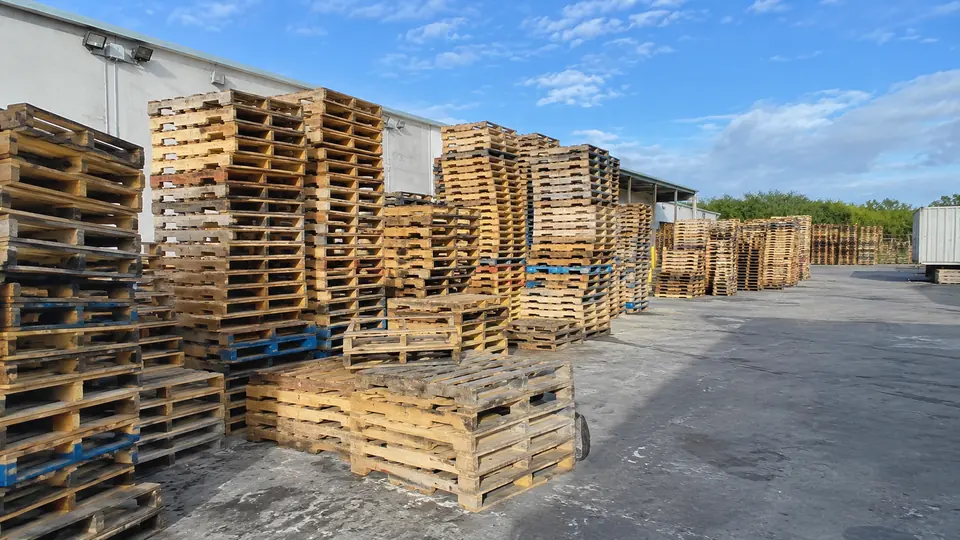
A repair shop that
happens to own a yard.
Most pallet companies are logistics firms with a saw out back. We built it the other way around: craft first, trucks second.
We open every unit
Incoming loads are broken down by hand, board by board. A single cracked stringer doesn't condemn a pallet — it schedules it.
We grade honestly
An A is an A. If a load prices as B, we say B and charge B. You will never open a trailer and find a surprise in it.
We mill what can't be saved
Shattered deck boards become runners. Runners become blocks. Blocks become fiber. The fourth life is still a life.
We publish the arithmetic
Every quote can carry a reuse ledger: board feet kept in service, kilograms of CO₂e avoided, tons diverted.
Six stations. One circle.
This is the whole company, in order. Pallets enter at station one and leave at station one again — usually five or six times before the wood is spent.
- 01
Collect
Our trailers pull your empties on a route, or on call. We pay on the spot for anything reusable.
- 02
Sort
Footprint, entry type, stringer vs block, moisture, stamps. Everything gets a destination before it gets a forklift.
- 03
Repair
Board swap, re-nail, re-plate, trim. Our benches turn out roughly 2,400 serviceable units a week.
- 04
Grade & stamp
A, B, #1, #2. Heat treatment and ISPM-15 stamping on site for anything crossing a border.
- 05
Deliver
Standing weekly orders, spot loads, or just-in-time drops synced to your dock hours.
- 06
Recover
Whatever finally fails becomes runners, blocks, animal bedding, mulch or boiler fiber. 0% landfill.
What one reused pallet actually buys the planet
Conservative, defensible numbers — the kind you can put in a sustainability report without a footnote fight.
A pallet is the most reused object in global trade and the least celebrated. We think that is backwards.
See the full ledger methodSix families of product
Recycled pallets
Grade A and B, #1 and #2, in every footprint we see often enough to keep on the ground. GMA 48×40 ships same week.
Built to specNew pallets
When reuse genuinely won't do — cleanroom, white-glove, or a footprint nobody has ever thrown away. Cut from responsibly sourced lumber.
Odd freightCustom crates & skids
One-off cases for machinery, art, prototypes and the thing your engineer swears is unshippable.
SystemsPallet accessories
Collars, lids, caps, runners, top frames, corner blocks — the parts that turn a flat deck into a box.
Second craftUpcycled goods
Bar fronts, planters, cladding, retail fixtures and furniture, built in our shop from boards with a provable history.
Last 4%Mulch, fiber & biomass
Ground wood for landscape, bedding, erosion control and boiler fuel. The end of the line that isn't a landfill.
The Grain Index™ — a fingerprint for the pallet you are about to order.
Type a footprint, a grade and a wood, and we draw its grain: a deterministic signature that never repeats for a different spec. It goes on your quote, your crate stencil and, if you want, the side of your trailer.
- Same spec, same grain, forever — it is arithmetic, not art direction.
- Comes with a reuse ledger for the quantity you type.
- Free. Faintly obsessive. Entirely ours.
Drawn to scale, because inches lie on a spec sheet
Three of the fourteen footprints we stock. The size guide covers tolerances, deflection, racking limits and why North America settled on 48×40.
Five industries, five different definitions of 'clean'
They showed up, counted our empties in front of us, wrote a number on the spot and paid it. After eleven years of 'we'll call you back', that was genuinely startling.
We needed 600 heat-treated units with a border crossing in four days. The stamps were dry before our broker finished the paperwork.
Long reads from the yard
Anatomy of a recycled pallet
Eleven named parts, four failure modes, and the one component that decides whether a unit lives or dies.
9 min readWhy 48×40 rules America
A grocery committee, a railcar door and a 1968 compromise that still shapes every warehouse aisle you walk.
7 min readMoisture content & mold
Nineteen percent is the number that matters, and almost nobody measures it. Here is how, and what to do at 24%.
Eighteen years, in figures rather than adjectives
All of it measured, most of it audited, none of it rounded up.
The whole catalogue in one table
Six families, what each is for, the minimum, the lead time and the honest limit on each.
| Family | What it is for | Minimum | Lead time | The honest limit |
|---|---|---|---|---|
| Recycled pallets | Nine jobs out of ten, in 14 footprints | 25 delivered / 5 collected | 2–5 business days | ±⅛" tolerance is not reliably achievable |
| New pallets | Cleanroom, ASRS, novel footprints, documented custody | 100 units | 5–10 business days | Highest carbon option; we quote recycled first |
| Custom crates & skids | Machinery, art, prototypes, export freight | 1 | 3–8 business days | Over 2,000 lb we need a drawing or a photo with a tape in frame |
| Accessories | Collars, lids, caps, frames, runners, corner blocks | By arrangement | 3–10 business days | Less protective than a sealed crate for fragile freight |
| Upcycled goods | Fixtures, cladding, furniture, planters | 1 commission | 2–6 weeks | HT stock only, and never anything food-contact |
| Mulch, fiber & biomass | Landscape, bedding, path, arena, boiler fuel | 10 cubic yards | 2–5 business days | 60-mile delivery radius; collect beyond it |
Full specifications, grades and tolerances are on the technical reference page — twenty tables, nothing gated.
What we
refuse to do.
A supplier who agrees to everything is either not listening or not planning to comply. Here is our list, in writing.
Stamp wood we did not treat
Not for anybody, at any price, for any deadline. The entire value of an ISPM-15 mark rests on it being true, and a yard that bends once has nothing left to sell.
Sell you a grade above the job
If a #2 survives the journey, we quote the #2 — even though the A-grade carries the better margin. Roughly one audit in five concludes a customer should change nothing at all.
Claim an EPAL licence
We are not a licensed EPAL manufacturer or repairer. We build metric-footprint one-way stock and say exactly that.
Fumigate
No methyl bromide, under any circumstances. Heat treatment only.
Certify a recycled unit's load rating
We publish representative figures for stock with individual histories and tested figures for new builds. Blurring those is how people end up over racking.
Take contaminated wood
Oil- or chemical-contaminated material is refused at the gate. Accepting it is how a zero-landfill claim quietly becomes false.
Quote a lane we know does not work
Past roughly 400 miles the freight exceeds the value of the wood. We will name a yard closer to you instead.
Where we run trailers, and where we honestly do not
Fifty states and 391 cities have a page. Each one says which of three things we can actually do for you there.
Texas
Our own trailers, our own benches, our own grading. Austin daily with same-day available; San Antonio, Houston and Dallas–Fort Worth on fixed weekly days.
14 Texas markets →OK · LA · AR · NM
Reached on loaded return legs. Volume moves are genuinely economic; small spot loads genuinely are not, and we will tell you which yours is.
The Triangle and beyond →The other 46
Vetted partner yards for the wood; specification, grading standards, sourcing audits, programme design and export documentation from us. Specification travels free; pallets do not.
Every state and city →The eight questions that start most conversations
What is your minimum order?
25 units for delivery, 5 for yard pickup. Bulk fiber starts at 10 cubic yards delivered, and mulch loading at the yard has no minimum if you bring a trailer.
Which grade should I buy?
Tell us what the pallet has to do and let us pick. Weight, whether it goes in racking, whether automation touches it, and whether it comes back — those four answers change the price far more than the market does.
Will you pay for broken pallets?
Yes. Broken units are the raw material for our repair bench, so we need them. The rate is lower than for reusable stock, but it is a payment rather than a disposal charge — stop paying a hauler to take inventory away.
How fast can you collect?
Inside 48 hours on an agreed route in the Austin metro, weekly on fixed days to San Antonio, Houston and Dallas–Fort Worth. Minimum 100 units or one trailer; yard drop-off starts at five.
Do you heat treat for export?
On site, usually inside 24 hours of a load being pulled. Core at 56 °C for 30 continuous minutes, chart trace filed per lot, retained three years. We never fumigate and never stamp untreated wood.
What moisture content should I specify?
19% maximum as a baseline, 15% for food contact or chilled service — and name the measurement method, because a ceiling without a method is a wish. Pin meter on random units per lot, reading recorded.
Why is there no phone number?
We never installed one and have stopped pretending that is an oversight. Email reaches a coordinator who can see the sort yard from their desk, and a written thread is traceable when a load is disputed three weeks later.
Is zero to landfill genuinely zero?
Yes — audited quarterly by a third party since 2016 and reported monthly by tonnage and stream. Part of how it stays zero is refusing material we cannot route responsibly.
Thirty-six pieces written at the benches
Not by an agency. Specification, compliance, economics and craft, with the arithmetic shown.
Your pallet count is wrong
In eleven years of walking other people's warehouses we have never found a count that matched the building. The gap runs 8 to 19 percent, always in the same direction.
Craft · 8 minThe fastener decides everything
A pallet is a nailed structure that happens to be made of wood. Forty cents of steel is the difference between five trips and twelve.
Materials · 10 minPlastic versus wood, honestly
We only sell wood, which is exactly why this comparison is worth reading. Four situations where plastic is the right engineering answer — and why it is wrong for almost everything else.
Eleven acres, on an ordinary week
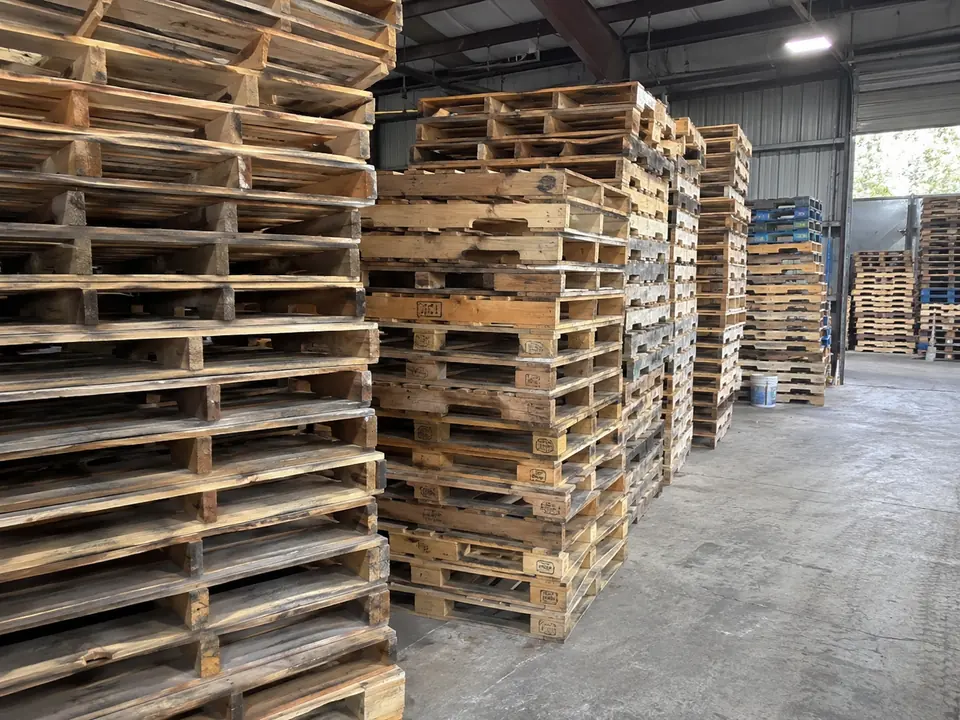
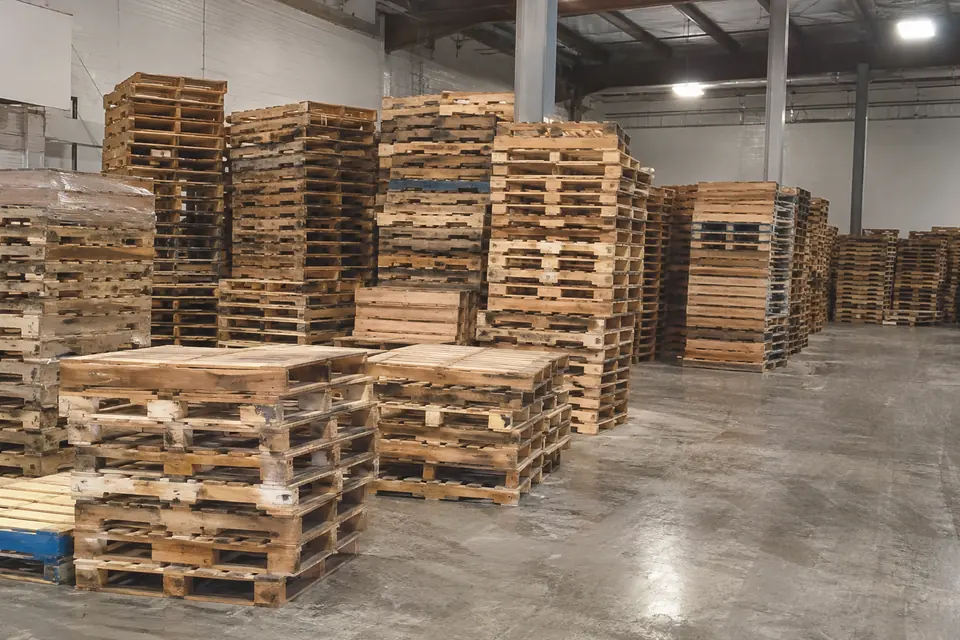
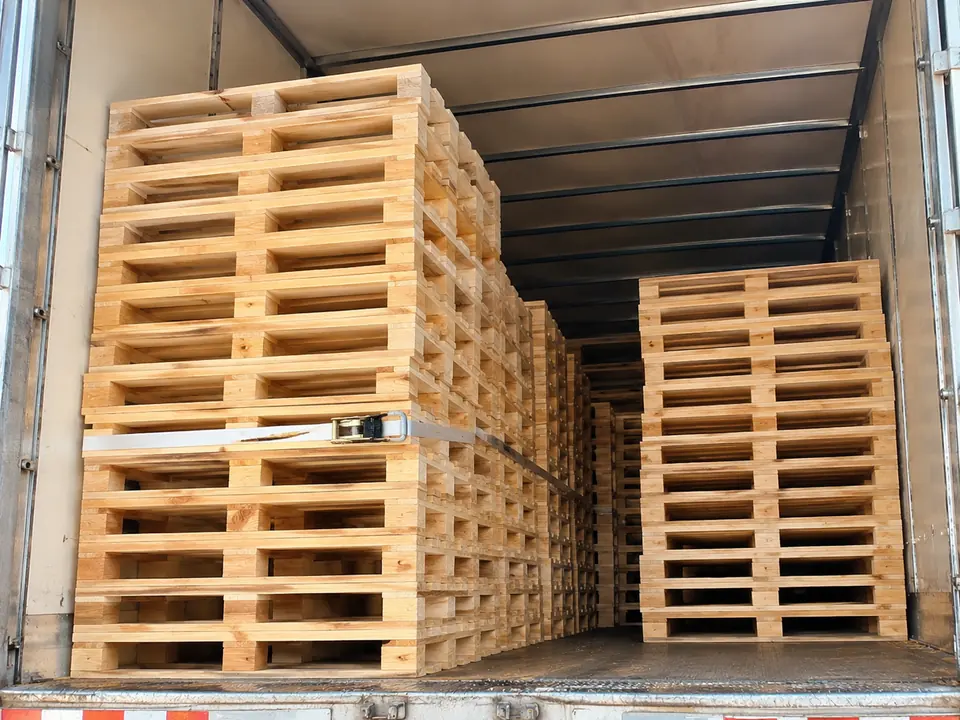
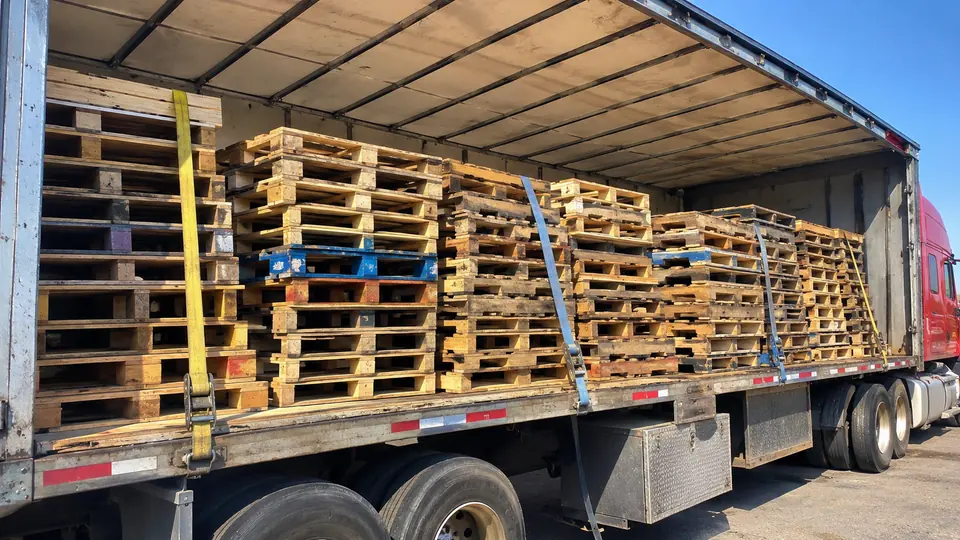
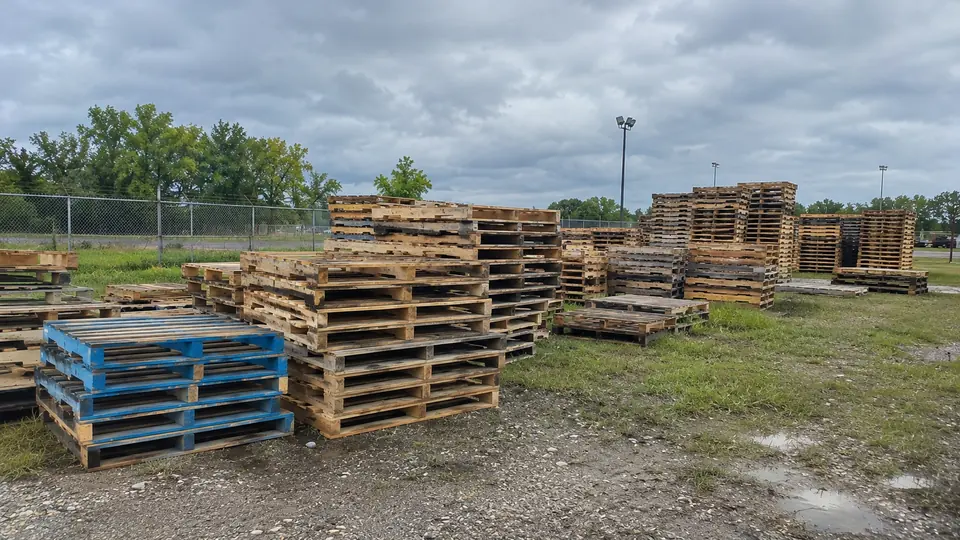
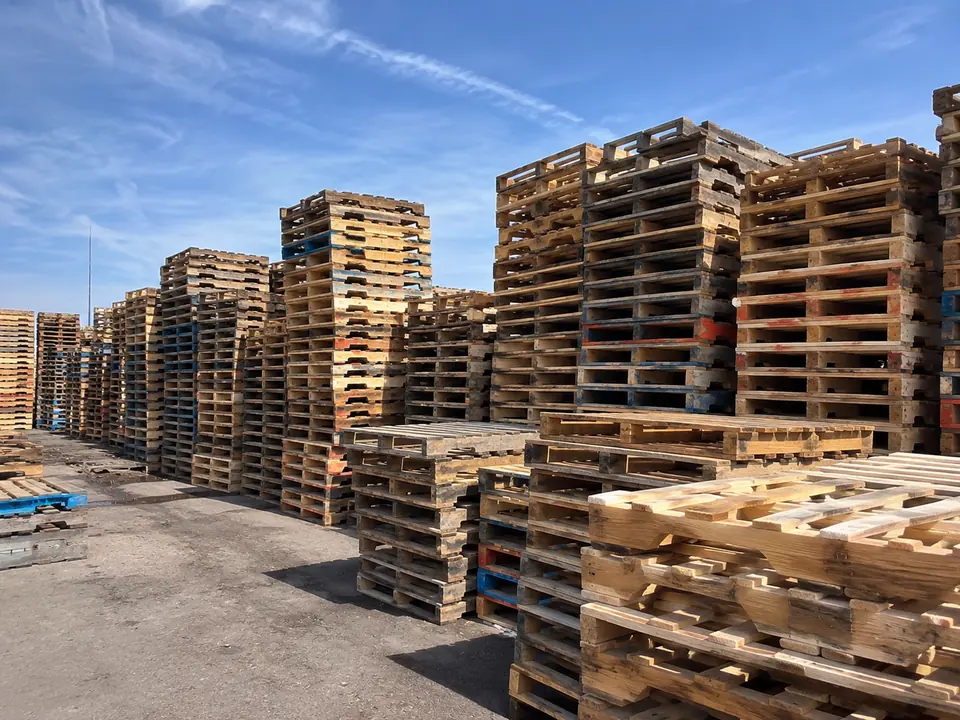
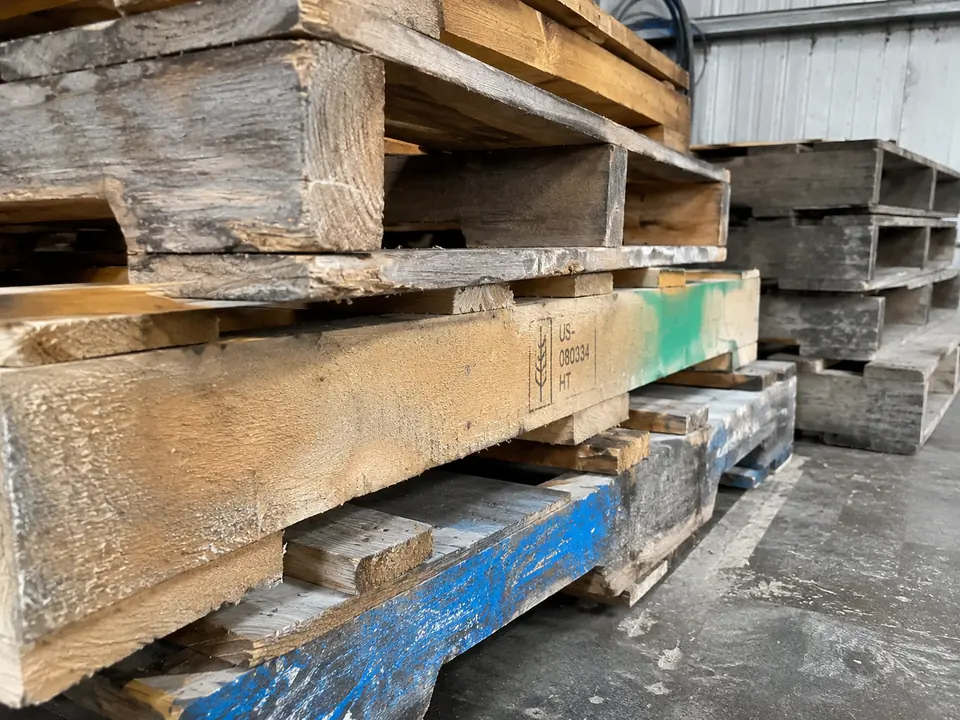
No stock photography and no renders. This is the sort shed, the dry stack, the intake lot and a trailer being loaded — taken on the days they happened to be taken.
We answer in writing, and we answer fast.
16550 Bratton Ln, Austin, TX 78728. Email reaches a coordinator who can see the yard from their desk.
Specification appendix
The reference tables behind everything above, in one place. These are the same figures our own benches and coordinators work from, and the same ones we will put in a written grading standard for your account.
Every footprint we stock
| Footprint | Inches | Millimetres | Construction | Where it lives | Our stock | Per 53' van |
|---|---|---|---|---|---|---|
| GMA 48×40 | 48" × 40" | 1219 × 1016 | Stringer & block | Grocery, general distribution, retail | Deep | 480–560 |
| 48×48 | 48" × 48" | 1219 × 1219 | Stringer | Drums, reels, wire, square loads | Good | 392–420 |
| 48×45 | 48" × 45" | 1219 × 1143 | Stringer | Automotive, tyre | Good | 420–450 |
| 48×42 | 48" × 42" | 1219 × 1067 | Stringer | Telecom, paint, coatings | Good | 440–480 |
| 42×42 | 42" × 42" | 1067 × 1067 | Stringer | Chemicals, drums, paint | Good | 480–520 |
| 40×48 | 40" × 48" | 1016 × 1219 | Stringer | Beverage, rotated GMA | Good | 480–560 |
| 40×40 | 40" × 40" | 1016 × 1016 | Stringer | Dairy, beverage, bakery | Good | 520–580 |
| 36×36 | 36" × 36" | 914 × 914 | Stringer | Compact, display, light goods | Good | 640–700 |
| 32×30 | 32" × 30" | 813 × 762 | Stringer | Retail display, in-store | Limited | 900+ |
| 30×30 | 30" × 30" | 762 × 762 | Stringer | Light goods, display | Limited | 960+ |
| 48×20 half | 48" × 20" | 1219 × 508 | Stringer | Retail half pallet, promotions | Limited | 1,000+ |
| EPAL 1 | 47.24" × 31.50" | 1200 × 800 | Block, 9 blocks | European trade, retail | To order | 540–600 |
| EPAL 2 / ISO | 47.24" × 39.37" | 1200 × 1000 | Block | Europe, Asia, best container fit | To order | 480–520 |
| Asia square | 43.30" × 43.30" | 1100 × 1100 | Block | Japan, east Asia | To order | 460–500 |
| AU square | 44.88" × 44.88" | 1140 × 1140 | Block | Australia, chemical CP series | To order | 440–480 |
Trailer counts are for stacked, unstrapped loads of sound recycled stock and vary with repair thickness. We confirm the actual count on the bill of lading rather than estimating it. Anything not on this list we cut from reclaim — see custom milling.
Grades, side by side
| Grade A | Grade B | #1 premium | #2 economy | Custom cut | |
|---|---|---|---|---|---|
| Original boards | All | Some replaced | All | Several replaced | Mixed |
| Companion boards | None | Permitted | None | Permitted | Permitted |
| Stringer plugs | None | Permitted | None | Permitted | Permitted |
| Metal plates | None | Permitted, disclosed | None | Permitted | Permitted |
| Squareness | Within ¼" | Within ½" | Within ¼" | Within ½" | Within ½" |
| Colour uniformity | High | Mixed | High | Mixed | Mixed, fresh saw ends |
| Protruding fasteners | Zero | Zero | Zero | Zero | Zero |
| Moisture ceiling | 19% (15% on request) | 19% | 19% (15% on request) | 19% | 19% |
| Typical service | Retail-facing, export | Internal, bulk | Automation, racking | One-way, yard storage | Odd footprints |
| Relative price | Highest recycled | −18 to −30% | High | Lowest | ≈⅓ of a new build |
| Remaining life | Longest | Shorter — already repaired once | Longest | Shortest | Varies |
Grade A and #1 overlap: we use #1 for units that needed no repair at all and A for units that are cosmetically uniform. Where a customer holds their own written standard, that document governs and supersedes these names.
Load ratings and unit weights
| Construction | Static | Dynamic | Racked (unsupported) | Unit weight |
|---|---|---|---|---|
| Recycled GMA 48×40 stringer, sound | 4,600 lb | 2,800 lb | 1,500 lb | 33–45 lb |
| Recycled 48×40 block, sound | 5,200 lb | 3,000 lb | 1,900 lb | 40–55 lb |
| Recycled 48×40 stringer, repaired (B) | 4,400 lb | 2,650 lb | 1,400 lb | 35–48 lb |
| New southern yellow pine, 5 top boards | 4,200 lb | 2,500 lb | 1,400 lb | 33–38 lb |
| New mixed hardwood block, 7 top boards | 6,000 lb | 3,500 lb | 2,400 lb | 48–58 lb |
| Heavy-duty new build, doubled stringers | 9,000 lb | 5,000 lb | 3,800 lb | 62–78 lb |
| Skid (no bottom deck) | 3,800 lb | 2,200 lb | Not for racking | 24–32 lb |
Representative planning figures for sound stock, not engineering certifications. Racked ratings assume the load spans two rails with nothing under the middle. Derate a further 20–30% for dwell times beyond a few weeks, because wood creeps under sustained load.
- Design ceiling: deflection of span ÷ 100 — about 0.4 inches across a 40-inch unsupported span.
- Orientation: rack a stringer pallet across the wrong axis and the deck boards carry the span instead of the stringers. Capacity can halve.
- Creep: wood deflects progressively under sustained load. A unit measured inside tolerance on day one can exceed it after six months in a rack.
- Stiffness, not strength, is the limit. Mixed hardwood outperforms southern yellow pine in racking by more than their strength figures suggest, because it is substantially stiffer.
- Drive-in racking gives a long unsupported span with no support at the leading edge. Derate hard, use block construction, consider full-perimeter bottom boards.
Tolerances that get argued about
- Overall footprint
- ±¼" is normal in recycled stock. ±⅛" is achievable on new builds and worth paying for only if you run automation.
- Squareness
- Diagonal difference under ½". Beyond that, racking and ASRS reject it, and stretch wrap tightens on two corners and slackens on the other two.
- Deck gap
- Typically 3½" between boards. Conveyor lines often need a maximum of 3". Specify the number in inches — it is not implied by a grade.
- Entry height
- Nominal 3½". A repair with thicker boards can lose ¼" and still look fine, then wedge a powered pallet jack.
- Board thickness
- Nominal ⅝" may measure 0.60–0.66". Specify a minimum if deck flatness matters to your product.
- Protruding fasteners
- Zero tolerance. Any nail standing above the deck surface condemns the unit at our bench.
- Moisture content
- 19% is the mould threshold and our standard ceiling. 15% on request for food contact and chilled service.
- Bark
- Some export destinations require debarked wood. Ask before you load, not after.
Species and what each one is good for
| Species | Relative density | Stiffness | Nail holding | Weight | Where we use it |
|---|---|---|---|---|---|
| Mixed hardwood (oak, maple, gum, hickory) | High | Highest | Excellent | Heaviest | Racked service, stringers, blocks, bedding feedstock |
| Red / white oak | High | High | Excellent | Heavy | Heavy-duty stringers, furniture stock |
| Southern yellow pine | Medium | Medium | Good for a softwood | Light | New builds, floor-stored service, crate framing |
| Poplar | Low–medium | Low | Moderate | Light | Collar panels, crate sheathing, light decks |
| Spruce / fir (inbound EU & Canadian units) | Low | Low | Moderate | Lightest | Arrives on imported pallets; harvested for light components |
| Mixed reclaim (unknown) | Varies | Varies | Varies | Varies | Graded on behaviour, never on a species claim |
A single Grade B recycled pallet can contain four species in no reliable proportion, which is why we grade on inspection rather than on a species label. Where stiffness genuinely matters, specify mixed hardwood — it is the cheapest real structural upgrade available.
Fasteners
| Fastener | How it holds | Relative withdrawal | Correct for | Wrong for |
|---|---|---|---|---|
| Ring (annular) shank | Rings bite into the fibre; withdrawal must tear wood | 1.8–2.2 | Deck boards, repairs, anywhere a fork strikes | — |
| Helical (screw) shank | Threads itself into the fibre as it drives | 1.7–2.1 | Stringers, blocks, hardwood | — |
| Smooth shank | Friction only; wood shrinks away from it | 1.0 (baseline) | Nothing in a pallet | Every pallet joint |
| Staples | Two thin legs, wide crown, large bearing area | 0.5–0.8 | Collar panels, crate sheathing, lids | Deck and stringer joints |
| Galvanised (any shank) | As above, corrosion resistant | As above | Outdoor and wash-down service | — |
Doubling withdrawal resistance roughly doubles the number of trips a unit survives, for a fastener cost measured in cents. We use ring-shank and helical only, and every unit that has been apart is fully re-nailed. The MIBANT bend-angle test is the industry's rough proxy for nail ductility: too brittle and it snaps on impact, too soft and the joint loosens.
Moisture
| Moisture content | What happens | Typical source | Freight weight |
|---|---|---|---|
| 6–12% | Indoor equilibrium. No mould risk. Dimensionally stable. | Kiln dried, stored inside | Lightest |
| 12–19% | Safe working range — our standard ceiling. | Covered dry stack | Normal |
| 19–25% | Mould within days to weeks in warm conditions. | Rain-exposed stacks, green lumber | +5–10% |
| 25–40% | Mould rapid, blue stain likely. | Pallets left in the open through a wet week | +10–20% |
| Above 40% | Saturated. You are paying freight on water. | Standing water, flooded yard | +20%+ |
Mould needs free water. Below roughly 19% the water in wood is chemically bound in the cell walls and spores cannot germinate; above it, they can. Heat treatment kills insects and confers no moisture guarantee; kiln drying reduces moisture and is not a phytosanitary treatment. They are separate claims and conflating them causes both mould claims and border holds.
How to specify, in ten lines
- Footprint, length first, in inches — and the carton pattern that produced it, so we can check for overhang.
- Construction: stringer or block, two-way or four-way entry. Specify block if you cannot control racking orientation.
- Maximum deck gap in inches. This is the number that decides whether a carton falls through your rollers, and no grade implies it.
- Minimum entry height if you run powered pallet jacks. Repairs with thicker boards quietly eat clearance.
- Squareness tolerance. ±¼" for racking and automation; ±½" is fine for floor storage and cheaper.
- Moisture ceiling, with the measurement method named. 19% standard, 15% for food contact or chilled service.
- Treatment: HT and ISPM-15 marked, and re-marked after any repair introducing untreated wood.
- Species, if stiffness matters. Mixed hardwood for racked service; southern yellow pine where nothing spans anything.
- Permitted repairs: plates allowed or not, companion boards allowed or not. Automation usually wants neither.
- Load case: weight, support condition, dwell time, whether it stacks. This is what lets us pick the grade rather than you guessing it.
Standards, testing and defects
What governs this trade, how pallets are actually tested, and the defect list our benches work from. Published because a specification you can check is worth more to us than a lead we captured.
The documents that govern wood packaging
| Document | Issued by | What it governs | Does it bind us? |
|---|---|---|---|
| ISPM-15 | IPPC / FAO | Phytosanitary treatment and marking of solid wood packaging crossing borders | Yes — we are a registered treating facility |
| ISO 6780 | ISO | The six recognised pallet footprints for international trade | Reference; we stock four of the six |
| ISO 8611-1/2/3 | ISO | Test methods, performance requirements and maximum working loads for flat pallets | Methods we quote; we do not issue certifications for recycled stock |
| ISO 18613 | ISO | Repair of flat wooden pallets | Our bench practice aligns with it |
| ASTM D1185 | ASTM | Standard test methods for pallets and related structures | Reference for new-build testing |
| ASTM D6179 | ASTM | Rough handling of unitised loads — incline impact, drop, vibration | Reference for unit-load advice |
| MIL-STD-1660 | US DoD | Design criteria for ammunition unit loads | Only on defence-adjacent work, by request |
| GMA specification | Grocery Manufacturers Association (historic) | The 48×40 footprint, board count and notch geometry | The de facto North American default |
| NWPCA uniform standard | National Wooden Pallet & Container Association | Recycled pallet grading vocabulary | Yes, unless a customer standard supersedes it |
| EPAL technical regulations | European Pallet Association | Licensed manufacture and repair of EUR/EPAL pallets | No — we hold no EPAL licence and say so |
| NHLA rules | National Hardwood Lumber Association | Hardwood lumber grading | Upstream of us; pallet stock sits below the appearance grades |
| ANSI MH1 | ANSI / MHI | Pallets, slip sheets and other material handling definitions | Terminology reference |
We list what does not bind us as deliberately as what does. A supplier vague about which standards it actually holds is the main avoidable risk in this trade.
Test methods and what each one tells you
| Test | What it simulates | What it tells you | Where it matters |
|---|---|---|---|
| Compression, edge-supported | Racking across two rails | Racked working load and deflection | The binding constraint in most warehouses |
| Compression, floor-supported | A load sitting on a flat floor | Static capacity — the biggest and least useful figure | Floor storage only |
| Bending, fork-supported | Lifting on forks | Dynamic capacity | Every movement |
| Incline impact (conbur) | Railcar coupling and hard braking | Whether the unit load stays together | Rail and long-haul road freight |
| Vibration, random and fixed-frequency | Hours of road or rail travel | Fastener loosening and load settlement | Long lanes; this is what kills smooth-shank nails |
| Drop and corner drop | Dock mishandling | Lead board and corner survivability | High-touch distribution |
| Fastener withdrawal | Joint failure under cycling | Service life more than anything else does | Every pallet, every time |
| Creep / sustained load | Months in a rack | Long-term deflection; derate 20–30% | Slow-moving stock, bagged goods |
| Moisture determination | Storage reality | Mould risk and freight weight | All food, chilled and humid-climate work |
We publish tested figures for new builds and representative figures for recycled stock. Every unit of reclaim has an individual history, so an engineering certification on recycled wood would imply a precision nobody can hold.
Defects, severity and what we do about each
| Defect | Where it shows | Severity | What our bench does |
|---|---|---|---|
| Lead board split lengthwise | Outermost top board, either end | Low | Board swap. Commonest repair in the trade; usually means a steep dock leveller |
| Interior deck board crack | Any top or bottom board | Low | Board swap, or companion board where removal would damage the stringer |
| End-grain separation | Board end, at the nail line | Terminal for that board | Board removed and harvested short, or ground. It predicts the next failure |
| Stringer crack, not crossing a notch | Outer or centre stringer | Medium | Plug if over a third of the depth; otherwise re-nail and pass |
| Stringer crack crossing a notch | At a notch corner | High | Plug or condemn. The load path through that stringer is gone |
| Protruding fastener | Anywhere on the deck | Zero tolerance | Driven or replaced before the unit leaves, no exceptions |
| Loose joint / creak | Whole unit | Medium | Full re-nail. A creaking pallet has already failed at the joints |
| Missing chamfer | Bottom board lead edge | Medium | Re-chamfer. Without it every pallet jack fights the unit |
| Out of square beyond ½" | Diagonals | Medium–high | Corrected or condemned. Racking, ASRS and stretch wrap all reject it |
| Moisture above 19% | Whole unit | High | Dry stack or kiln before repair. Mould is then a question of time |
| Blue stain / sapstain | Sapwood faces | Cosmetic, plus odour | Rejected for food and absorbent product; fine elsewhere |
| Bark / wane | Board edges | Low, unless export | Removed where a destination requires debarked wood |
| Mould, visible | Any surface | Reject | Never shipped to a food account; dried and re-graded or ground |
| Paint, stain, coating | Any surface | Reject | Segregated at the gate; industrial fuel stream only |
| Oil or chemical contamination | Any surface | Refused | Refused at the gate and the customer is told why |
| Embedded metal beyond fasteners | Anywhere | High | Removed by hand before any grind; it destroys knives |
Fastener specifications
| Fastener | Typical length | Wire gauge | MIBANT bend angle | Used in |
|---|---|---|---|---|
| Helical, hardened | 2¼"–2½" | 0.099–0.120" | 10–20° | Stringers and blocks, hardwood |
| Helical, standard | 2"–2¼" | 0.099–0.113" | 20–30° | Stringers in softwood |
| Ring shank, hardened | 1¾"–2¼" | 0.099–0.113" | 15–25° | Deck boards, repairs |
| Ring shank, standard | 1½"–2" | 0.092–0.105" | 25–35° | Deck boards, lighter stock |
| Ring shank, galvanised | 1¾"–2¼" | 0.099–0.113" | 20–30° | Outdoor and wash-down service |
| Staple, crown | 1¼"–1¾" | 16–15 gauge | n/a | Collar panels, crate sheathing, lids |
| Smooth shank | any | any | any | Nothing we build |
A lower MIBANT angle means harder, more brittle steel — better withdrawal, more prone to shearing on impact. A higher angle means softer steel that bends rather than snapping, and joints that loosen. Pallet builders pick a window; cheap builders pick a price. 60 to 78 fasteners go into a standard GMA unit.
Commercial appendix
The arithmetic behind a pallet decision, the sector matrix, and the four decision trees we walk customers through.
Cost per trip, worked
| Line | One-way recycled | Repaired recycled, 6 trips | New build, 10 trips | Pooled rental |
|---|---|---|---|---|
| Unit cost delivered | $11.50 | $13.00 | $26.00 | $0 capital |
| Useful trips | 1 | 6 | 10 | per trip |
| Cost of the asset per trip | $11.50 | $2.17 | $2.60 | $5.50 issue fee |
| Freight per trip | $1.80 | $1.80 | $1.80 | included |
| Repair share per trip | — | $0.55 | $0.42 | included |
| Handling labour per trip | $0.90 | $0.90 | $0.90 | $0.90 |
| Loss / non-return per trip | n/a | $0.30 | $0.75 | $2.10–6.00 |
| Disposal | $0.40 | credit | credit | n/a |
| Cost per trip | $14.60 | $5.72 | $6.47 | $8.50–12.40 |
A worked illustration using mid-2020s Central Texas figures, not a quotation. The decisive line is loss: pooling and new builds are both excellent until units stop coming back, and the pooled range above reflects return rates between 90% and 55%. Model your own return rate before you model anything else.
Building your own model
- Delivered unit cost. Not the quoted unit price — add the freight to your dock.
- Useful trips per unit. Ask your supplier, then halve it until you have your own data.
- Return rate. Of units leaving your building, how many come back into your control? Operations assume 80% and discover 45%.
- Repair cost and repair rate. What share needs work per cycle, and at what price.
- Handling labour. Count touches, multiply by minutes, multiply by fully loaded labour cost.
- Disposal or credit. A yard that pays for broken units turns this line from a cost into revenue.
- Failure cost. Rare, expensive, and the reason cheapest-per-unit is not cheapest-per-trip.
- Then divide. Total cost ÷ useful trips. That is the only number worth negotiating on.
What each sector actually needs
| Sector | Usual footprint | Usual grade | The spec that matters most | Failure that costs most |
|---|---|---|---|---|
| Grocery & retail distribution | 48×40 | A / #1 | Deck gap and appearance | Rejection at a retail DC door |
| Food manufacturing | 48×40 | A / #1 | Moisture ≤15% | Mould transfer to packaging |
| Beverage | 48×40, 40×48 | A / B | Racked rating, deck strength | Rack deflection under dense load |
| Construction & building supply | 48×40, 48×48 | B / #2 | Racked rating, outdoor creep | Rack incident under bagged goods |
| Agriculture & produce | 48×40, bins | B, HT only | Ventilation, treatment segregation | Chemically treated wood near feed |
| Chemicals & paint | 42×42, 48×48 | A / B | Square footprint, drum stability | Drum shift in transit |
| Automotive | 48×45, custom | A / new | Tolerance, returnable design | Line stoppage |
| Pharmaceutical | 48×40, new | New / plastic | Documented custody, cleanability | Audit failure |
| 3PL & warehousing | Mixed | Per client | Asset tracking, written standards | Unbilled pallet leakage |
| Manufacturing & electronics | Custom, 48×40 | A / #1 / new | Squareness, entry height | ASRS rejection, jammed jack |
| Export & freight forwarding | Destination's | B + HT | ISPM-15 truth | Container held on a quay |
| Hospitality & events | 48×40, half | B / #2 | Collection frequency | Service corridor blocked |
Decision trees
Recycled, new, or cut down?
- Does a standard footprint fit your carton pattern with no overhang? If yes → recycled.
- If no: does an oversized footprint exist in reclaim that can be sawn to your size? If yes → cut down, at roughly a third of a new build.
- Does anything automated read the pallet's geometry, or do you need ±⅛"? If yes → new build.
- Is the racked load above about 2,500 lb? If yes → new build, mixed hardwood, block construction.
- Is a documented chain of custody for the wood itself part of an audit? If yes → new build.
- Otherwise → recycled, at the lowest grade that survives the journey.
Buy, own a fleet, or rent from a pool?
- Measure your return rate first. Everything below depends on it and nothing else matters as much.
- Below 50% return → your pallet is packaging. Buy recycled one-way and price it as consumable.
- 50–85% return → the messy middle. Buy recycled on a managed programme, with collection on the same movements.
- Above 85% return, with controlled geography → own a fleet and use toll repair to keep your asset numbers.
- Mandated by a retailer's pool, or shipping to hundreds of points needing identical quality → pool rental, and budget for loss charges.
- Wash-down hygiene is a process requirement → plastic, and we will point you to somebody who sells it.
Stringer or block?
- Does it go into racking where you cannot guarantee orientation? Block.
- Do powered jacks enter from the 48" side? Block.
- Automated storage and retrieval? Block, or new.
- Heavy load sitting for months? Block, mixed hardwood.
- European or ISO-metric footprint? Block by specification, not preference.
- Otherwise → stringer: lighter, cheaper, deeper in recycled stock and easier to repair.
Repair or replace?
- Crack crossing a notch, or more than a third of a stringer's depth? Plug, or condemn.
- Three or more stringer repairs already present? Condemn — that is a pallet held together by optimism.
- Four or more deck boards gone on a low-value footprint? Harvest the boards.
- Above 24% moisture? Dry stack first, then decide.
- Contaminated with oil, chemicals or paint? Out of every reuse stream, permanently.
- Otherwise → repair and re-nail fully, at roughly a third of replacement cost.