Recycling & reclamation
Send us your wood waste — pallets, crates, dunnage, offcuts, broken collars — and it leaves our yard as pallets, boards, bedding, mulch or fuel. None of it leaves as landfill.
Set up a recycling pickup
Twelve seconds of typing beats a week of phone tag. Everything you send lands with a coordinator who knows the yard inventory.
- Landfill rate
- 0.0%
- Audit cadence
- Quarterly, third party
- Reporting
- Monthly diversion statements
- Accepts
- Clean wood only
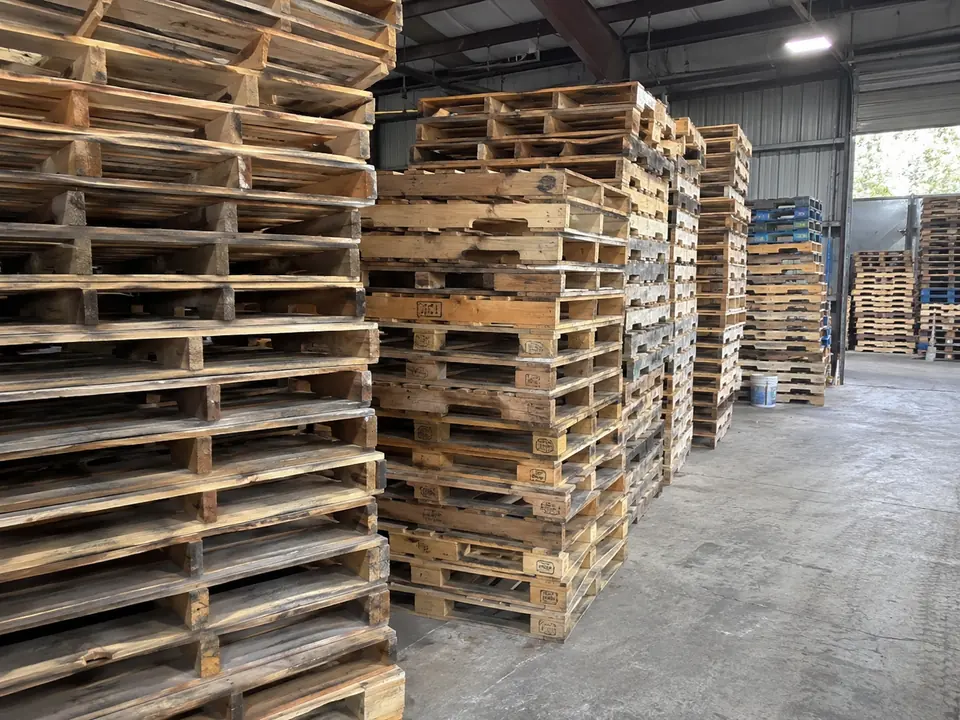
Zero to landfill is an easy thing to claim and a tedious thing to prove. We do the tedious version.
What we accept
- Pallets of any footprint and condition, including completely shattered units
- Wood crates, cases and skids, knocked down or whole
- Dunnage, blocking, bracing and bearers
- Pallet collars, lids, caps and top frames
- Clean lumber offcuts and trim from manufacturing
- Wooden reels and spools (hardware removed by us)
What we cannot take
- Painted, stained, varnished or pressure-treated lumber
- Engineered panel — MDF, particleboard, OSB, melamine
- Wood contaminated with food residue, chemicals or hydrocarbons
- Anything with embedded concrete, glass or significant steel
The diversion hierarchy we actually follow
- 01
Reuse whole
If the unit works, it goes straight to grading. No processing, no energy, highest value.
- 02
Repair
Board swap or re-nail returns it to service. Still a pallet, still cheap.
- 03
Harvest
Good boards come off a dead unit and go to the repair bench for other pallets.
- 04
Remanufacture
Harvested timber becomes a cut-down pallet, a crate component or a collar panel.
- 05
Fiber
Grind to mulch, bedding or path fiber — still a material, not a fuel.
- 06
Energy
Last resort: hog fuel to a regional boiler. Only for wood that cannot safely be a material.
Monthly diversion statements
Tonnage received, tonnage reused, tonnage ground, tonnage to fuel, landfill tonnage (zero), with the lot numbers behind each figure. Written for an auditor, not a brochure.
How the audit worksService appendix
Lead times, minimums and the process behind them. Published rather than quoted on request, because a lead time you can plan around is worth more than a lead time that sounds good.
Every service, with its lead time
| Service | Lead time | Minimum | Notes |
|---|---|---|---|
| Paid pallet collection, Austin metro | 48 hours, routed | 100 units or 1 trailer | Counted with your team present, signed on the dock |
| Paid collection, Texas Triangle | Weekly, fixed day | 1 trailer | Backhaul lanes to SA, Houston, DFW |
| Yard drop-off | Open during yard hours | 5 units | Saturday mornings are easiest; no appointment |
| Spot load, common footprint | 2–5 business days | 25 units delivered | Subject to grade availability |
| Standing order | Fixed day each week | By agreement | Annual pricing, ≈2 weeks of safety stock held here |
| Repair, toll (your units) | 3–7 business days | 100 units | Your asset numbers and stamps retained |
| Heat treatment & ISPM-15 stamping | Usually 24 hours | By agreement | 4–9 hour cycle; chart trace filed per lot |
| New build to spec | 5–10 business days | 100 units | Tolerance ±⅛" achievable |
| Cut-down to custom footprint | 3–6 business days | 50 units | Tolerance ±¼" |
| Custom crate, one-off | 3–8 business days | 1 | On-site crating available in Austin metro |
| Custom milling, cut list | 3–6 business days | 1 shop hour | Tolerance ±1/16" dimensional |
| Bulk mulch or bedding | 2–5 business days | 10 cu yd | 60 mile delivery radius |
| Sourcing audit | By arrangement | 500 units/week | Half a day on site; free above that volume |
| Same-day, Austin metro | Same day | By arrangement | Premium rate, when a line is about to stop |
All times Central. Lead times are commitments we take seriously and not guarantees against weather, road closure or equipment failure.
What happens between the gate and the trailer
- 01
Gate & segregation
Weighbridge ticket, then sorting by treatment type and origin before anything is cut. Painted, treated or unknown-origin wood is separated here and never enters the mulch or bedding lines. Contaminated material is refused.
- 02
Breakdown & inspection
Units are broken down and inspected board by board. Deck boards are flexed by hand; anything that creaks, splits at a nail hole or shows end-grain separation comes off.
- 03
Stringer judgement
Cracks longer than a third of the stringer depth, or any crack crossing a notch, send the member to the plug bench or condemn it. This single check decides most of the economics.
- 04
Repair & re-nail
Board swap, companion board, plug, plate, trim. Then every fastener on the unit is driven or replaced — the invisible half of the work, and the part cheap yards skip.
- 05
Moisture & square
Pin meter on random units per lot, reading recorded. Diagonals measured; out-of-square beyond ½" is corrected, not shipped. Above 19% MC the load waits in the dry stack or goes through the kiln.
- 06
Grade, stamp & lot
Grade, build date and lot in soy ink on a stringer face, so a disputed load traces back to the bench and shift that built it. Heat treatment and IPPC marking for anything crossing a border.
The repair vocabulary
| Repair | What it is | Bench time | Effect on grade |
|---|---|---|---|
| Board swap | Cracked deck board out, sound reclaimed board of equal thickness in | 60–90 sec | A → B |
| Companion board | A second board nailed alongside a cracked original | 45 sec | A → B |
| Stringer plug | Cracked stringer section cut out, matching plug let in and double-nailed | 3–5 min | A → B |
| Metal plate | Galvanised plate across a stringer crack | 45 sec | A → B, disclosed |
| Full re-nail | Every fastener on the unit driven or replaced | 90–120 sec | No change — standard on anything apart |
| Trim / cut-down | Oversized unit sawn to a smaller footprint, cut edge re-nailed and chamfered | 4–8 min | Becomes a custom unit |
| Re-stamp | ISPM-15 mark re-applied after re-treatment | — | No change |
| Condemn & harvest | Sound boards to the repair bench, remainder to fiber | 2 min | — |
We never plate a stringer and call it Grade A, and never hide a companion board under a label. The four checks at the bench, in order: stringers sound? how many deck boards gone? end-grain separation? is the footprint worth the labour?
Where every pound goes
| Stream | Destination | Share of intake mass | Verified by |
|---|---|---|---|
| Reusable whole | Grading and resale | 71% | Unit counts + weighbridge |
| Repairable | Repair benches | 20% | Bench lot records |
| Board harvest | Repair stock for other units | 3% | Internal transfer tickets |
| Remanufacture | Cut-downs, crate components, collar panels, furniture | 2% | Shop records |
| Material grind | Mulch, bedding, path and arena fiber | 3% | Grind batch weights |
| Industrial fuel | Regional boiler — never called recycling | 1% | Outbound scale tickets |
| Metal | Scrap recycler by weight | <1% | Scrap receipts |
| Landfill | — | 0.0% | Quarterly third-party audit since 2016 |
2025 averages by mass. Landfill has no row because it has no tonnage. Part of how that stays true is refusing material we cannot route: painted, stained or pressure-treated lumber, engineered panel, and anything contaminated with food residue, chemicals or hydrocarbons.
What drives the price you are quoted
| Cost component | Share of a recycled unit | What moves it |
|---|---|---|
| Labour | 35–45% | Local wages. The largest and stickiest cost. |
| Core acquisition | 20–30% | What we pay warehouses for their empties. The main driver of market swings. |
| Freight | 15–25% | Diesel, driver availability, truckload capacity. Pallets are mostly air. |
| Repair materials | 5–10% | Fasteners; harvested boards cost labour rather than lumber. |
| Yard, plant and compliance | 5–10% | Rent, grinder, chambers, audits, insurance. |
| New lumber | 0% on a recycled unit | Sets the price of a new pallet, which sets a ceiling on recycled by substitution. |
This is why a falling lumber futures chart does not translate into a proportional fall in recycled prices: there is no new lumber in the cost structure. Lumber spikes pull recycled prices up quickly on demand; lumber crashes push them down slowly, because the cost floor is labour and nobody's wages fell.
And when in the year you are quoting it
| Period | Core supply | Demand | Price pressure |
|---|---|---|---|
| January – February | Plentiful — post-holiday backlog clears | Soft | Lowest |
| March – May | Normal | Rising — spring construction and beverage | Firming |
| June – August | Tightening — summer slowdowns, heat limits bench output | High — beverage peak | Firm |
| September – November | Tight — everything is shipping, nothing is sitting still | Peak — pre-holiday build | Highest |
| December | Erratic | Falling fast after mid-month | Falling |
Central Texas pattern. Agricultural regions invert parts of it — harvest demand can make September the tightest month for an entirely different reason. A standing order with annual pricing gives up the January bargain and avoids the September shock, which is a trade most operations should make.
Commercial appendix
The arithmetic behind a pallet decision, the sector matrix, and the four decision trees we walk customers through.
Cost per trip, worked
| Line | One-way recycled | Repaired recycled, 6 trips | New build, 10 trips | Pooled rental |
|---|---|---|---|---|
| Unit cost delivered | $11.50 | $13.00 | $26.00 | $0 capital |
| Useful trips | 1 | 6 | 10 | per trip |
| Cost of the asset per trip | $11.50 | $2.17 | $2.60 | $5.50 issue fee |
| Freight per trip | $1.80 | $1.80 | $1.80 | included |
| Repair share per trip | — | $0.55 | $0.42 | included |
| Handling labour per trip | $0.90 | $0.90 | $0.90 | $0.90 |
| Loss / non-return per trip | n/a | $0.30 | $0.75 | $2.10–6.00 |
| Disposal | $0.40 | credit | credit | n/a |
| Cost per trip | $14.60 | $5.72 | $6.47 | $8.50–12.40 |
A worked illustration using mid-2020s Central Texas figures, not a quotation. The decisive line is loss: pooling and new builds are both excellent until units stop coming back, and the pooled range above reflects return rates between 90% and 55%. Model your own return rate before you model anything else.
Building your own model
- Delivered unit cost. Not the quoted unit price — add the freight to your dock.
- Useful trips per unit. Ask your supplier, then halve it until you have your own data.
- Return rate. Of units leaving your building, how many come back into your control? Operations assume 80% and discover 45%.
- Repair cost and repair rate. What share needs work per cycle, and at what price.
- Handling labour. Count touches, multiply by minutes, multiply by fully loaded labour cost.
- Disposal or credit. A yard that pays for broken units turns this line from a cost into revenue.
- Failure cost. Rare, expensive, and the reason cheapest-per-unit is not cheapest-per-trip.
- Then divide. Total cost ÷ useful trips. That is the only number worth negotiating on.
What each sector actually needs
| Sector | Usual footprint | Usual grade | The spec that matters most | Failure that costs most |
|---|---|---|---|---|
| Grocery & retail distribution | 48×40 | A / #1 | Deck gap and appearance | Rejection at a retail DC door |
| Food manufacturing | 48×40 | A / #1 | Moisture ≤15% | Mould transfer to packaging |
| Beverage | 48×40, 40×48 | A / B | Racked rating, deck strength | Rack deflection under dense load |
| Construction & building supply | 48×40, 48×48 | B / #2 | Racked rating, outdoor creep | Rack incident under bagged goods |
| Agriculture & produce | 48×40, bins | B, HT only | Ventilation, treatment segregation | Chemically treated wood near feed |
| Chemicals & paint | 42×42, 48×48 | A / B | Square footprint, drum stability | Drum shift in transit |
| Automotive | 48×45, custom | A / new | Tolerance, returnable design | Line stoppage |
| Pharmaceutical | 48×40, new | New / plastic | Documented custody, cleanability | Audit failure |
| 3PL & warehousing | Mixed | Per client | Asset tracking, written standards | Unbilled pallet leakage |
| Manufacturing & electronics | Custom, 48×40 | A / #1 / new | Squareness, entry height | ASRS rejection, jammed jack |
| Export & freight forwarding | Destination's | B + HT | ISPM-15 truth | Container held on a quay |
| Hospitality & events | 48×40, half | B / #2 | Collection frequency | Service corridor blocked |
Decision trees
Recycled, new, or cut down?
- Does a standard footprint fit your carton pattern with no overhang? If yes → recycled.
- If no: does an oversized footprint exist in reclaim that can be sawn to your size? If yes → cut down, at roughly a third of a new build.
- Does anything automated read the pallet's geometry, or do you need ±⅛"? If yes → new build.
- Is the racked load above about 2,500 lb? If yes → new build, mixed hardwood, block construction.
- Is a documented chain of custody for the wood itself part of an audit? If yes → new build.
- Otherwise → recycled, at the lowest grade that survives the journey.
Buy, own a fleet, or rent from a pool?
- Measure your return rate first. Everything below depends on it and nothing else matters as much.
- Below 50% return → your pallet is packaging. Buy recycled one-way and price it as consumable.
- 50–85% return → the messy middle. Buy recycled on a managed programme, with collection on the same movements.
- Above 85% return, with controlled geography → own a fleet and use toll repair to keep your asset numbers.
- Mandated by a retailer's pool, or shipping to hundreds of points needing identical quality → pool rental, and budget for loss charges.
- Wash-down hygiene is a process requirement → plastic, and we will point you to somebody who sells it.
Stringer or block?
- Does it go into racking where you cannot guarantee orientation? Block.
- Do powered jacks enter from the 48" side? Block.
- Automated storage and retrieval? Block, or new.
- Heavy load sitting for months? Block, mixed hardwood.
- European or ISO-metric footprint? Block by specification, not preference.
- Otherwise → stringer: lighter, cheaper, deeper in recycled stock and easier to repair.
Repair or replace?
- Crack crossing a notch, or more than a third of a stringer's depth? Plug, or condemn.
- Three or more stringer repairs already present? Condemn — that is a pallet held together by optimism.
- Four or more deck boards gone on a low-value footprint? Harvest the boards.
- Above 24% moisture? Dry stack first, then decide.
- Contaminated with oil, chemicals or paint? Out of every reuse stream, permanently.
- Otherwise → repair and re-nail fully, at roughly a third of replacement cost.