Fifty states, one honest map.
51 states and 391 cities, each with a page that says plainly which of three things we can do for you there — run our own trailers, reach you on a backhaul lane, or source locally and bring the specification work ourselves.
Find out what we can do where you are
Your postal code tells us which of the three applies. We will say so in the reply, including when the answer is “use a yard closer to you”.
- States & DC
- 51
- City pages
- 391
- Direct service
- Texas
- Everywhere else
- Honestly described
Texas
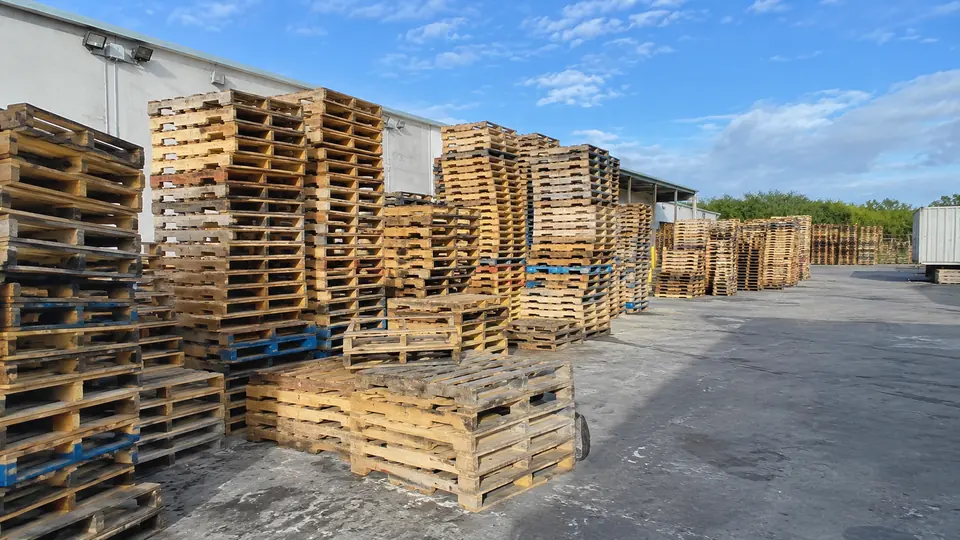
This is home. Collection, supply, repair, heat treatment, milling and fiber all run out of the Austin yard, on our own equipment, to a grading standard we write with you.
OK · LA · AR · NM
We reach this state on backhaul — a trailer that has already delivered and would otherwise run empty. That makes volume moves genuinely economic and small spot loads genuinely not. We will tell you which yours is before you commit anything.
The other 46
Pallets are high-cube, low-value freight: trucking them across a continent destroys both the price and the environmental case. So here we work through vetted partner yards for the physical wood, and do what travels well ourselves — specification, grading standards, sourcing audits, multi-site programme design and export documentation.
Pallets stop making economic and environmental sense somewhere around four hundred miles. We would rather tell you that than sell you the freight.
South
Our own region. Texas is served directly; its neighbours sit on lanes we already run.
- TXTexasDirect service14
- OKOklahomaBackhaul lane8
- LALouisianaBackhaul lane8
- ARArkansasBackhaul lane8
- ALAlabamaNetwork & sourcing8
- FLFloridaNetwork & sourcing9
- GAGeorgiaNetwork & sourcing8
- NCNorth CarolinaNetwork & sourcing8
- SCSouth CarolinaNetwork & sourcing8
- TNTennesseeNetwork & sourcing8
- KYKentuckyNetwork & sourcing7
- MSMississippiNetwork & sourcing8
- VAVirginiaNetwork & sourcing8
- WVWest VirginiaNetwork & sourcing6
- MDMarylandNetwork & sourcing8
- DEDelawareNetwork & sourcing6
- DCDistrict of ColumbiaNetwork & sourcing1
Midwest
Rail intermodal, grain and automotive — the densest pallet manufacturing base in North America.
- ILIllinoisNetwork & sourcing9
- INIndianaNetwork & sourcing8
- OHOhioNetwork & sourcing8
- MIMichiganNetwork & sourcing8
- WIWisconsinNetwork & sourcing8
- MNMinnesotaNetwork & sourcing8
- IAIowaNetwork & sourcing8
- MOMissouriNetwork & sourcing8
- KSKansasNetwork & sourcing8
- NENebraskaNetwork & sourcing8
- NDNorth DakotaNetwork & sourcing6
- SDSouth DakotaNetwork & sourcing6
Northeast
Tight geography, old buildings, expensive dock labour and a lot of imported freight.
West
Long distances, big ports and the most import-driven pallet flow in the country.
- NMNew MexicoBackhaul lane8
- CACaliforniaNetwork & sourcing12
- AZArizonaNetwork & sourcing9
- NVNevadaNetwork & sourcing7
- UTUtahNetwork & sourcing7
- COColoradoNetwork & sourcing8
- WAWashingtonNetwork & sourcing9
- OROregonNetwork & sourcing8
- IDIdahoNetwork & sourcing7
- MTMontanaNetwork & sourcing7
- WYWyomingNetwork & sourcing7
- AKAlaskaNetwork & sourcing6
- HIHawaiiNetwork & sourcing6
Most “nationwide” pallet pages are a lie of omission.
They list five hundred cities and imply a yard in each one. We list them too — and then tell you which column you are in. It costs us some enquiries and saves everybody a pointless phone call we could not take anyway.
Asked on every one of these pages
Why does a pallet company care about distance?
Because a trailer of pallets is mostly air. A 53-foot van holds roughly 500 units worth a few thousand dollars, so freight is a large share of delivered cost. Past about four hundred miles the freight exceeds the value of the wood, and the carbon saved by reusing is spent again on diesel.
So what is the point of a page for a city you don't truck to?
Specification travels free. Most pallet money is lost to the wrong grade, an ignored racked rating, an unmeasured moisture content or a false ISPM-15 mark — none of which depend on who hauls the wood. These pages exist to fix that, and to introduce you to a vetted local yard if that is all you need.
Can you run a programme across several states?
Yes, and that is the main reason the network exists. One written grading standard, one monthly diversion and cost-per-trip report, local wood in each market.
Do you charge for sourcing or specification work?
Not for operations above roughly 500 units a week — it pays for itself if you then buy through the programme. Below that, we will still answer your questions by email, because it takes ten minutes and we would rather you got it right.
Reference appendix
What we can supply, what it weighs, how many fit on a trailer, and how long it takes — the same tables wherever you are reading this from.
Footprints and trailer counts
| Footprint | Inches | Millimetres | Construction | Where it lives | Our stock | Per 53' van |
|---|---|---|---|---|---|---|
| GMA 48×40 | 48" × 40" | 1219 × 1016 | Stringer & block | Grocery, general distribution, retail | Deep | 480–560 |
| 48×48 | 48" × 48" | 1219 × 1219 | Stringer | Drums, reels, wire, square loads | Good | 392–420 |
| 48×45 | 48" × 45" | 1219 × 1143 | Stringer | Automotive, tyre | Good | 420–450 |
| 48×42 | 48" × 42" | 1219 × 1067 | Stringer | Telecom, paint, coatings | Good | 440–480 |
| 42×42 | 42" × 42" | 1067 × 1067 | Stringer | Chemicals, drums, paint | Good | 480–520 |
| 40×48 | 40" × 48" | 1016 × 1219 | Stringer | Beverage, rotated GMA | Good | 480–560 |
| 40×40 | 40" × 40" | 1016 × 1016 | Stringer | Dairy, beverage, bakery | Good | 520–580 |
| 36×36 | 36" × 36" | 914 × 914 | Stringer | Compact, display, light goods | Good | 640–700 |
| 32×30 | 32" × 30" | 813 × 762 | Stringer | Retail display, in-store | Limited | 900+ |
| 30×30 | 30" × 30" | 762 × 762 | Stringer | Light goods, display | Limited | 960+ |
| 48×20 half | 48" × 20" | 1219 × 508 | Stringer | Retail half pallet, promotions | Limited | 1,000+ |
| EPAL 1 | 47.24" × 31.50" | 1200 × 800 | Block, 9 blocks | European trade, retail | To order | 540–600 |
| EPAL 2 / ISO | 47.24" × 39.37" | 1200 × 1000 | Block | Europe, Asia, best container fit | To order | 480–520 |
| Asia square | 43.30" × 43.30" | 1100 × 1100 | Block | Japan, east Asia | To order | 460–500 |
| AU square | 44.88" × 44.88" | 1140 × 1140 | Block | Australia, chemical CP series | To order | 440–480 |
Trailer counts are for stacked, unstrapped loads of sound recycled stock and vary with repair thickness. We confirm the actual count on the bill of lading rather than estimating it. Anything not on this list we cut from reclaim — see custom milling.
Grades
| Grade A | Grade B | #1 premium | #2 economy | Custom cut | |
|---|---|---|---|---|---|
| Original boards | All | Some replaced | All | Several replaced | Mixed |
| Companion boards | None | Permitted | None | Permitted | Permitted |
| Stringer plugs | None | Permitted | None | Permitted | Permitted |
| Metal plates | None | Permitted, disclosed | None | Permitted | Permitted |
| Squareness | Within ¼" | Within ½" | Within ¼" | Within ½" | Within ½" |
| Colour uniformity | High | Mixed | High | Mixed | Mixed, fresh saw ends |
| Protruding fasteners | Zero | Zero | Zero | Zero | Zero |
| Moisture ceiling | 19% (15% on request) | 19% | 19% (15% on request) | 19% | 19% |
| Typical service | Retail-facing, export | Internal, bulk | Automation, racking | One-way, yard storage | Odd footprints |
| Relative price | Highest recycled | −18 to −30% | High | Lowest | ≈⅓ of a new build |
| Remaining life | Longest | Shorter — already repaired once | Longest | Shortest | Varies |
Grade A and #1 overlap: we use #1 for units that needed no repair at all and A for units that are cosmetically uniform. Where a customer holds their own written standard, that document governs and supersedes these names.
Lead times and minimums
| Service | Lead time | Minimum | Notes |
|---|---|---|---|
| Paid pallet collection, Austin metro | 48 hours, routed | 100 units or 1 trailer | Counted with your team present, signed on the dock |
| Paid collection, Texas Triangle | Weekly, fixed day | 1 trailer | Backhaul lanes to SA, Houston, DFW |
| Yard drop-off | Open during yard hours | 5 units | Saturday mornings are easiest; no appointment |
| Spot load, common footprint | 2–5 business days | 25 units delivered | Subject to grade availability |
| Standing order | Fixed day each week | By agreement | Annual pricing, ≈2 weeks of safety stock held here |
| Repair, toll (your units) | 3–7 business days | 100 units | Your asset numbers and stamps retained |
| Heat treatment & ISPM-15 stamping | Usually 24 hours | By agreement | 4–9 hour cycle; chart trace filed per lot |
| New build to spec | 5–10 business days | 100 units | Tolerance ±⅛" achievable |
| Cut-down to custom footprint | 3–6 business days | 50 units | Tolerance ±¼" |
| Custom crate, one-off | 3–8 business days | 1 | On-site crating available in Austin metro |
| Custom milling, cut list | 3–6 business days | 1 shop hour | Tolerance ±1/16" dimensional |
| Bulk mulch or bedding | 2–5 business days | 10 cu yd | 60 mile delivery radius |
| Sourcing audit | By arrangement | 500 units/week | Half a day on site; free above that volume |
| Same-day, Austin metro | Same day | By arrangement | Premium rate, when a line is about to stop |
All times Central. Lead times are commitments we take seriously and not guarantees against weather, road closure or equipment failure.
Container and trailer fit
| Equipment | Internal width | Internal length | 1200×1000 per floor | 1200×800 per floor | 48"×40" per floor |
|---|---|---|---|---|---|
| 20' standard container | ≈2,352 mm | ≈5,898 mm | 10 | 11 | 10 |
| 40' standard container | ≈2,352 mm | ≈12,032 mm | 20–21 | 23–24 | 20–21 |
| 40' high cube container | ≈2,352 mm | ≈12,032 mm | 20–21 | 23–24 | 20–21 |
| 45' high cube container | ≈2,352 mm | ≈13,556 mm | 23–24 | 26–27 | 23–24 |
| 53' domestic dry van | ≈2,591 mm | ≈16,154 mm | 26 | 30 | 26 |
| 48' dry van | ≈2,591 mm | ≈14,630 mm | 24 | 27 | 24 |
Floor positions only; stacking depends on product height and weight. The fundamental tension in global freight is in this table: a 40-foot container's internal width does not comfortably take two 48-inch pallets, because the container and the American pallet were standardised in different traditions and never reconciled.
How to specify, in ten lines
- Footprint, length first, in inches — and the carton pattern that produced it, so we can check for overhang.
- Construction: stringer or block, two-way or four-way entry. Specify block if you cannot control racking orientation.
- Maximum deck gap in inches. This is the number that decides whether a carton falls through your rollers, and no grade implies it.
- Minimum entry height if you run powered pallet jacks. Repairs with thicker boards quietly eat clearance.
- Squareness tolerance. ±¼" for racking and automation; ±½" is fine for floor storage and cheaper.
- Moisture ceiling, with the measurement method named. 19% standard, 15% for food contact or chilled service.
- Treatment: HT and ISPM-15 marked, and re-marked after any repair introducing untreated wood.
- Species, if stiffness matters. Mixed hardwood for racked service; southern yellow pine where nothing spans anything.
- Permitted repairs: plates allowed or not, companion boards allowed or not. Automation usually wants neither.
- Load case: weight, support condition, dwell time, whether it stacks. This is what lets us pick the grade rather than you guessing it.
Moisture
| Moisture content | What happens | Typical source | Freight weight |
|---|---|---|---|
| 6–12% | Indoor equilibrium. No mould risk. Dimensionally stable. | Kiln dried, stored inside | Lightest |
| 12–19% | Safe working range — our standard ceiling. | Covered dry stack | Normal |
| 19–25% | Mould within days to weeks in warm conditions. | Rain-exposed stacks, green lumber | +5–10% |
| 25–40% | Mould rapid, blue stain likely. | Pallets left in the open through a wet week | +10–20% |
| Above 40% | Saturated. You are paying freight on water. | Standing water, flooded yard | +20%+ |
Mould needs free water. Below roughly 19% the water in wood is chemically bound in the cell walls and spores cannot germinate; above it, they can. Heat treatment kills insects and confers no moisture guarantee; kiln drying reduces moisture and is not a phytosanitary treatment. They are separate claims and conflating them causes both mould claims and border holds.
Commercial appendix
The arithmetic behind a pallet decision, the sector matrix, and the four decision trees we walk customers through.
Cost per trip, worked
| Line | One-way recycled | Repaired recycled, 6 trips | New build, 10 trips | Pooled rental |
|---|---|---|---|---|
| Unit cost delivered | $11.50 | $13.00 | $26.00 | $0 capital |
| Useful trips | 1 | 6 | 10 | per trip |
| Cost of the asset per trip | $11.50 | $2.17 | $2.60 | $5.50 issue fee |
| Freight per trip | $1.80 | $1.80 | $1.80 | included |
| Repair share per trip | — | $0.55 | $0.42 | included |
| Handling labour per trip | $0.90 | $0.90 | $0.90 | $0.90 |
| Loss / non-return per trip | n/a | $0.30 | $0.75 | $2.10–6.00 |
| Disposal | $0.40 | credit | credit | n/a |
| Cost per trip | $14.60 | $5.72 | $6.47 | $8.50–12.40 |
A worked illustration using mid-2020s Central Texas figures, not a quotation. The decisive line is loss: pooling and new builds are both excellent until units stop coming back, and the pooled range above reflects return rates between 90% and 55%. Model your own return rate before you model anything else.
Building your own model
- Delivered unit cost. Not the quoted unit price — add the freight to your dock.
- Useful trips per unit. Ask your supplier, then halve it until you have your own data.
- Return rate. Of units leaving your building, how many come back into your control? Operations assume 80% and discover 45%.
- Repair cost and repair rate. What share needs work per cycle, and at what price.
- Handling labour. Count touches, multiply by minutes, multiply by fully loaded labour cost.
- Disposal or credit. A yard that pays for broken units turns this line from a cost into revenue.
- Failure cost. Rare, expensive, and the reason cheapest-per-unit is not cheapest-per-trip.
- Then divide. Total cost ÷ useful trips. That is the only number worth negotiating on.
What each sector actually needs
| Sector | Usual footprint | Usual grade | The spec that matters most | Failure that costs most |
|---|---|---|---|---|
| Grocery & retail distribution | 48×40 | A / #1 | Deck gap and appearance | Rejection at a retail DC door |
| Food manufacturing | 48×40 | A / #1 | Moisture ≤15% | Mould transfer to packaging |
| Beverage | 48×40, 40×48 | A / B | Racked rating, deck strength | Rack deflection under dense load |
| Construction & building supply | 48×40, 48×48 | B / #2 | Racked rating, outdoor creep | Rack incident under bagged goods |
| Agriculture & produce | 48×40, bins | B, HT only | Ventilation, treatment segregation | Chemically treated wood near feed |
| Chemicals & paint | 42×42, 48×48 | A / B | Square footprint, drum stability | Drum shift in transit |
| Automotive | 48×45, custom | A / new | Tolerance, returnable design | Line stoppage |
| Pharmaceutical | 48×40, new | New / plastic | Documented custody, cleanability | Audit failure |
| 3PL & warehousing | Mixed | Per client | Asset tracking, written standards | Unbilled pallet leakage |
| Manufacturing & electronics | Custom, 48×40 | A / #1 / new | Squareness, entry height | ASRS rejection, jammed jack |
| Export & freight forwarding | Destination's | B + HT | ISPM-15 truth | Container held on a quay |
| Hospitality & events | 48×40, half | B / #2 | Collection frequency | Service corridor blocked |
Decision trees
Recycled, new, or cut down?
- Does a standard footprint fit your carton pattern with no overhang? If yes → recycled.
- If no: does an oversized footprint exist in reclaim that can be sawn to your size? If yes → cut down, at roughly a third of a new build.
- Does anything automated read the pallet's geometry, or do you need ±⅛"? If yes → new build.
- Is the racked load above about 2,500 lb? If yes → new build, mixed hardwood, block construction.
- Is a documented chain of custody for the wood itself part of an audit? If yes → new build.
- Otherwise → recycled, at the lowest grade that survives the journey.
Buy, own a fleet, or rent from a pool?
- Measure your return rate first. Everything below depends on it and nothing else matters as much.
- Below 50% return → your pallet is packaging. Buy recycled one-way and price it as consumable.
- 50–85% return → the messy middle. Buy recycled on a managed programme, with collection on the same movements.
- Above 85% return, with controlled geography → own a fleet and use toll repair to keep your asset numbers.
- Mandated by a retailer's pool, or shipping to hundreds of points needing identical quality → pool rental, and budget for loss charges.
- Wash-down hygiene is a process requirement → plastic, and we will point you to somebody who sells it.
Stringer or block?
- Does it go into racking where you cannot guarantee orientation? Block.
- Do powered jacks enter from the 48" side? Block.
- Automated storage and retrieval? Block, or new.
- Heavy load sitting for months? Block, mixed hardwood.
- European or ISO-metric footprint? Block by specification, not preference.
- Otherwise → stringer: lighter, cheaper, deeper in recycled stock and easier to repair.
Repair or replace?
- Crack crossing a notch, or more than a third of a stringer's depth? Plug, or condemn.
- Three or more stringer repairs already present? Condemn — that is a pallet held together by optimism.
- Four or more deck boards gone on a low-value footprint? Harvest the boards.
- Above 24% moisture? Dry stack first, then decide.
- Contaminated with oil, chemicals or paint? Out of every reuse stream, permanently.
- Otherwise → repair and re-nail fully, at roughly a third of replacement cost.