Euro & EPAL sizes
1200×800 mm, four-way block construction, eleven nails per block and a licence plate on the corner. The most tightly specified pallet in commercial use — and the one Americans most often get wrong.
Source metric pallets
Twelve seconds of typing beats a week of phone tag. Everything you send lands with a coordinator who knows the yard inventory.
- EUR / EPAL 1
- 1200 × 800 mm
- Weight
- 22–25 kg
- Entry
- True four-way, block
- US stock
- Limited, usually to order
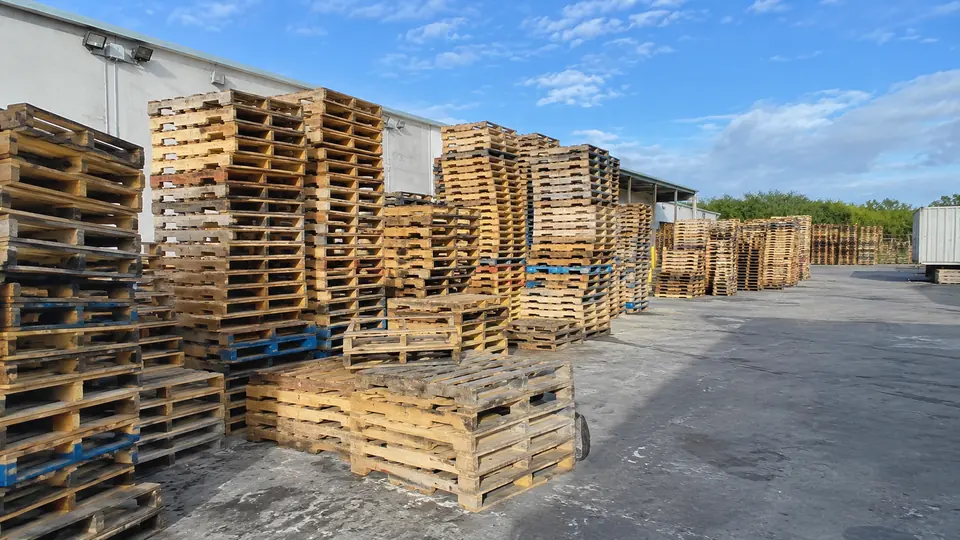
A Euro pallet is not a size. It is a licence, a construction standard and an inspection regime that happens to have a size attached.
The family
| Designation | Millimetres | Inches | Typical use |
|---|---|---|---|
| EPAL 1 (EUR / EUR 1) | 1200 × 800 × 144 | 47.24" × 31.50" | The European standard; retail and industrial |
| EPAL 2 (EUR 2) | 1200 × 1000 × 162 | 47.24" × 39.37" | Heavier industrial, closer to US proportions |
| EPAL 3 (EUR 3) | 1000 × 1200 × 144 | 39.37" × 47.24" | Rotated EPAL 2; chemical and beverage |
| EPAL 6 (EUR 6) | 800 × 600 × 144 | 31.50" × 23.62" | Half pallet; retail display |
| Quarter pallet | 600 × 400 | 23.62" × 15.75" | Display and in-store |
| ISO metric | 1200 × 1000 | 47.24" × 39.37" | ISO 6780 overlap with EPAL 2 |
What makes a pallet an EPAL pallet
- Nine blocks, not stringers — true four-way entry from every face
- 78 specified nails of specified type, driven in a specified pattern
- Corner branding: EUR or EPAL in an oval on the corner blocks, plus the licence number
- IPPC / ISPM-15 mark on the centre block of the long side
- Kiln-dried lumber to a specified moisture content
- Licensed manufacture and licensed repair — a repair by an unlicensed shop voids the classification
Honest limits on what we can supply
We are not an EPAL-licensed manufacturer or repairer, and we will not pretend otherwise. What we can do: source genuine used EPAL stock through import channels when the volume justifies it; build metric-footprint pallets to 1200×800 or 1200×1000 for one-way export where exchangeability is irrelevant; and tell you clearly which of those two you actually need. Nine times in ten, a one-way export does not need an EPAL licence plate — it needs the right footprint and a valid ISPM-15 mark.
- We can build
- Metric-footprint one-way pallets, block or stringer, HT and ISPM-15 stamped
- We can source
- Used genuine EPAL stock, to order, lead time typically 3–5 weeks
- We cannot do
- EPAL-licensed new manufacture, or licensed EPAL repair
- We will tell you
- Which of the three you actually need, before you spend anything
Can I ship on a 48×40 to Europe?
Physically yes, commercially often no. European racking, trucks and in-store equipment are built around 1200×800. A 48×40 will not fit two-across in a standard European trailer the way a Euro pallet does, and your receiver will handle it badly.
Is 1200×800 just 48×32?
Close but not equal: 1200 mm is 47.24", 800 mm is 31.50". Those fractions of an inch matter to automated equipment and to anybody building a rack.
What about CP pallets?
The chemical-industry CP1–CP9 series are separate standards again, mostly 1200×1000 and 1140×1140. Ask and we will dig up the geometry.
Dimensional appendix
Everything numeric, collected. If you only bookmark one part of this site, make it this.
Footprints
| Footprint | Inches | Millimetres | Construction | Where it lives | Our stock | Per 53' van |
|---|---|---|---|---|---|---|
| GMA 48×40 | 48" × 40" | 1219 × 1016 | Stringer & block | Grocery, general distribution, retail | Deep | 480–560 |
| 48×48 | 48" × 48" | 1219 × 1219 | Stringer | Drums, reels, wire, square loads | Good | 392–420 |
| 48×45 | 48" × 45" | 1219 × 1143 | Stringer | Automotive, tyre | Good | 420–450 |
| 48×42 | 48" × 42" | 1219 × 1067 | Stringer | Telecom, paint, coatings | Good | 440–480 |
| 42×42 | 42" × 42" | 1067 × 1067 | Stringer | Chemicals, drums, paint | Good | 480–520 |
| 40×48 | 40" × 48" | 1016 × 1219 | Stringer | Beverage, rotated GMA | Good | 480–560 |
| 40×40 | 40" × 40" | 1016 × 1016 | Stringer | Dairy, beverage, bakery | Good | 520–580 |
| 36×36 | 36" × 36" | 914 × 914 | Stringer | Compact, display, light goods | Good | 640–700 |
| 32×30 | 32" × 30" | 813 × 762 | Stringer | Retail display, in-store | Limited | 900+ |
| 30×30 | 30" × 30" | 762 × 762 | Stringer | Light goods, display | Limited | 960+ |
| 48×20 half | 48" × 20" | 1219 × 508 | Stringer | Retail half pallet, promotions | Limited | 1,000+ |
| EPAL 1 | 47.24" × 31.50" | 1200 × 800 | Block, 9 blocks | European trade, retail | To order | 540–600 |
| EPAL 2 / ISO | 47.24" × 39.37" | 1200 × 1000 | Block | Europe, Asia, best container fit | To order | 480–520 |
| Asia square | 43.30" × 43.30" | 1100 × 1100 | Block | Japan, east Asia | To order | 460–500 |
| AU square | 44.88" × 44.88" | 1140 × 1140 | Block | Australia, chemical CP series | To order | 440–480 |
Trailer counts are for stacked, unstrapped loads of sound recycled stock and vary with repair thickness. We confirm the actual count on the bill of lading rather than estimating it. Anything not on this list we cut from reclaim — see custom milling.
Container and trailer fit
| Equipment | Internal width | Internal length | 1200×1000 per floor | 1200×800 per floor | 48"×40" per floor |
|---|---|---|---|---|---|
| 20' standard container | ≈2,352 mm | ≈5,898 mm | 10 | 11 | 10 |
| 40' standard container | ≈2,352 mm | ≈12,032 mm | 20–21 | 23–24 | 20–21 |
| 40' high cube container | ≈2,352 mm | ≈12,032 mm | 20–21 | 23–24 | 20–21 |
| 45' high cube container | ≈2,352 mm | ≈13,556 mm | 23–24 | 26–27 | 23–24 |
| 53' domestic dry van | ≈2,591 mm | ≈16,154 mm | 26 | 30 | 26 |
| 48' dry van | ≈2,591 mm | ≈14,630 mm | 24 | 27 | 24 |
Floor positions only; stacking depends on product height and weight. The fundamental tension in global freight is in this table: a 40-foot container's internal width does not comfortably take two 48-inch pallets, because the container and the American pallet were standardised in different traditions and never reconciled.
Load ratings
| Construction | Static | Dynamic | Racked (unsupported) | Unit weight |
|---|---|---|---|---|
| Recycled GMA 48×40 stringer, sound | 4,600 lb | 2,800 lb | 1,500 lb | 33–45 lb |
| Recycled 48×40 block, sound | 5,200 lb | 3,000 lb | 1,900 lb | 40–55 lb |
| Recycled 48×40 stringer, repaired (B) | 4,400 lb | 2,650 lb | 1,400 lb | 35–48 lb |
| New southern yellow pine, 5 top boards | 4,200 lb | 2,500 lb | 1,400 lb | 33–38 lb |
| New mixed hardwood block, 7 top boards | 6,000 lb | 3,500 lb | 2,400 lb | 48–58 lb |
| Heavy-duty new build, doubled stringers | 9,000 lb | 5,000 lb | 3,800 lb | 62–78 lb |
| Skid (no bottom deck) | 3,800 lb | 2,200 lb | Not for racking | 24–32 lb |
Representative planning figures for sound stock, not engineering certifications. Racked ratings assume the load spans two rails with nothing under the middle. Derate a further 20–30% for dwell times beyond a few weeks, because wood creeps under sustained load.
- Design ceiling: deflection of span ÷ 100 — about 0.4 inches across a 40-inch unsupported span.
- Orientation: rack a stringer pallet across the wrong axis and the deck boards carry the span instead of the stringers. Capacity can halve.
- Creep: wood deflects progressively under sustained load. A unit measured inside tolerance on day one can exceed it after six months in a rack.
- Stiffness, not strength, is the limit. Mixed hardwood outperforms southern yellow pine in racking by more than their strength figures suggest, because it is substantially stiffer.
- Drive-in racking gives a long unsupported span with no support at the leading edge. Derate hard, use block construction, consider full-perimeter bottom boards.
Tolerances
- Overall footprint
- ±¼" is normal in recycled stock. ±⅛" is achievable on new builds and worth paying for only if you run automation.
- Squareness
- Diagonal difference under ½". Beyond that, racking and ASRS reject it, and stretch wrap tightens on two corners and slackens on the other two.
- Deck gap
- Typically 3½" between boards. Conveyor lines often need a maximum of 3". Specify the number in inches — it is not implied by a grade.
- Entry height
- Nominal 3½". A repair with thicker boards can lose ¼" and still look fine, then wedge a powered pallet jack.
- Board thickness
- Nominal ⅝" may measure 0.60–0.66". Specify a minimum if deck flatness matters to your product.
- Protruding fasteners
- Zero tolerance. Any nail standing above the deck surface condemns the unit at our bench.
- Moisture content
- 19% is the mould threshold and our standard ceiling. 15% on request for food contact and chilled service.
- Bark
- Some export destinations require debarked wood. Ask before you load, not after.
Grades
| Grade A | Grade B | #1 premium | #2 economy | Custom cut | |
|---|---|---|---|---|---|
| Original boards | All | Some replaced | All | Several replaced | Mixed |
| Companion boards | None | Permitted | None | Permitted | Permitted |
| Stringer plugs | None | Permitted | None | Permitted | Permitted |
| Metal plates | None | Permitted, disclosed | None | Permitted | Permitted |
| Squareness | Within ¼" | Within ½" | Within ¼" | Within ½" | Within ½" |
| Colour uniformity | High | Mixed | High | Mixed | Mixed, fresh saw ends |
| Protruding fasteners | Zero | Zero | Zero | Zero | Zero |
| Moisture ceiling | 19% (15% on request) | 19% | 19% (15% on request) | 19% | 19% |
| Typical service | Retail-facing, export | Internal, bulk | Automation, racking | One-way, yard storage | Odd footprints |
| Relative price | Highest recycled | −18 to −30% | High | Lowest | ≈⅓ of a new build |
| Remaining life | Longest | Shorter — already repaired once | Longest | Shortest | Varies |
Grade A and #1 overlap: we use #1 for units that needed no repair at all and A for units that are cosmetically uniform. Where a customer holds their own written standard, that document governs and supersedes these names.
Moisture and equilibrium
| Moisture content | What happens | Typical source | Freight weight |
|---|---|---|---|
| 6–12% | Indoor equilibrium. No mould risk. Dimensionally stable. | Kiln dried, stored inside | Lightest |
| 12–19% | Safe working range — our standard ceiling. | Covered dry stack | Normal |
| 19–25% | Mould within days to weeks in warm conditions. | Rain-exposed stacks, green lumber | +5–10% |
| 25–40% | Mould rapid, blue stain likely. | Pallets left in the open through a wet week | +10–20% |
| Above 40% | Saturated. You are paying freight on water. | Standing water, flooded yard | +20%+ |
Mould needs free water. Below roughly 19% the water in wood is chemically bound in the cell walls and spores cannot germinate; above it, they can. Heat treatment kills insects and confers no moisture guarantee; kiln drying reduces moisture and is not a phytosanitary treatment. They are separate claims and conflating them causes both mould claims and border holds.
| Air temperature | Relative humidity | Equilibrium moisture content | Dew point — a pallet colder than this will sweat |
|---|---|---|---|
| 68 °F | 30% | ≈6% | ≈36 °F |
| 68 °F | 40% | ≈7.7% | ≈43 °F |
| 68 °F | 55% | ≈10.2% | ≈51 °F |
| 68 °F | 70% | ≈13.1% | ≈58 °F |
| 68 °F | 85% | ≈18.5% | ≈64 °F |
| 55 °F | 60% | ≈11.3% | ≈41 °F |
| 75 °F | 65% | ≈12.4% | ≈62 °F |
Approximate, for planning. Two separate lessons: wood will eventually equilibrate to whatever air it sits in, and any pallet colder than the dew point of your building's air will condense water on itself and then on your cartons. Acclimatise cold stock indoors for four to twelve hours before loading.
Conversions
| Inches | mm | Millimetres | Inches | Other |
|---|---|---|---|---|
| 20" | 508 | 600 mm | 23.62" | 1 board foot = 144 in³ |
| 24" | 610 | 800 mm | 31.50" | 1 cu yd = 27 cu ft |
| 30" | 762 | 1,000 mm | 39.37" | 1 short ton = 2,000 lb |
| 32" | 813 | 1,100 mm | 43.30" | 1 kg = 2.205 lb |
| 36" | 914 | 1,140 mm | 44.88" | 1" = 25.4 mm exactly |
| 40" | 1,016 | 1,200 mm | 47.24" | 56 °C = 132.8 °F |
| 42" | 1,067 | 1,219 mm | 48.00" | 19% MC = mould threshold |
| 44" | 1,118 | 1,016 mm | 40.00" | 32 bf ≈ one GMA unit |
| 45" | 1,143 | 914 mm | 36.00" | L/100 = deflection ceiling |
| 48" | 1,219 | 762 mm | 30.00" | ≈500 units per 53' van |
Standards, testing and defects
What governs this trade, how pallets are actually tested, and the defect list our benches work from. Published because a specification you can check is worth more to us than a lead we captured.
The documents that govern wood packaging
| Document | Issued by | What it governs | Does it bind us? |
|---|---|---|---|
| ISPM-15 | IPPC / FAO | Phytosanitary treatment and marking of solid wood packaging crossing borders | Yes — we are a registered treating facility |
| ISO 6780 | ISO | The six recognised pallet footprints for international trade | Reference; we stock four of the six |
| ISO 8611-1/2/3 | ISO | Test methods, performance requirements and maximum working loads for flat pallets | Methods we quote; we do not issue certifications for recycled stock |
| ISO 18613 | ISO | Repair of flat wooden pallets | Our bench practice aligns with it |
| ASTM D1185 | ASTM | Standard test methods for pallets and related structures | Reference for new-build testing |
| ASTM D6179 | ASTM | Rough handling of unitised loads — incline impact, drop, vibration | Reference for unit-load advice |
| MIL-STD-1660 | US DoD | Design criteria for ammunition unit loads | Only on defence-adjacent work, by request |
| GMA specification | Grocery Manufacturers Association (historic) | The 48×40 footprint, board count and notch geometry | The de facto North American default |
| NWPCA uniform standard | National Wooden Pallet & Container Association | Recycled pallet grading vocabulary | Yes, unless a customer standard supersedes it |
| EPAL technical regulations | European Pallet Association | Licensed manufacture and repair of EUR/EPAL pallets | No — we hold no EPAL licence and say so |
| NHLA rules | National Hardwood Lumber Association | Hardwood lumber grading | Upstream of us; pallet stock sits below the appearance grades |
| ANSI MH1 | ANSI / MHI | Pallets, slip sheets and other material handling definitions | Terminology reference |
We list what does not bind us as deliberately as what does. A supplier vague about which standards it actually holds is the main avoidable risk in this trade.
Test methods and what each one tells you
| Test | What it simulates | What it tells you | Where it matters |
|---|---|---|---|
| Compression, edge-supported | Racking across two rails | Racked working load and deflection | The binding constraint in most warehouses |
| Compression, floor-supported | A load sitting on a flat floor | Static capacity — the biggest and least useful figure | Floor storage only |
| Bending, fork-supported | Lifting on forks | Dynamic capacity | Every movement |
| Incline impact (conbur) | Railcar coupling and hard braking | Whether the unit load stays together | Rail and long-haul road freight |
| Vibration, random and fixed-frequency | Hours of road or rail travel | Fastener loosening and load settlement | Long lanes; this is what kills smooth-shank nails |
| Drop and corner drop | Dock mishandling | Lead board and corner survivability | High-touch distribution |
| Fastener withdrawal | Joint failure under cycling | Service life more than anything else does | Every pallet, every time |
| Creep / sustained load | Months in a rack | Long-term deflection; derate 20–30% | Slow-moving stock, bagged goods |
| Moisture determination | Storage reality | Mould risk and freight weight | All food, chilled and humid-climate work |
We publish tested figures for new builds and representative figures for recycled stock. Every unit of reclaim has an individual history, so an engineering certification on recycled wood would imply a precision nobody can hold.
Defects, severity and what we do about each
| Defect | Where it shows | Severity | What our bench does |
|---|---|---|---|
| Lead board split lengthwise | Outermost top board, either end | Low | Board swap. Commonest repair in the trade; usually means a steep dock leveller |
| Interior deck board crack | Any top or bottom board | Low | Board swap, or companion board where removal would damage the stringer |
| End-grain separation | Board end, at the nail line | Terminal for that board | Board removed and harvested short, or ground. It predicts the next failure |
| Stringer crack, not crossing a notch | Outer or centre stringer | Medium | Plug if over a third of the depth; otherwise re-nail and pass |
| Stringer crack crossing a notch | At a notch corner | High | Plug or condemn. The load path through that stringer is gone |
| Protruding fastener | Anywhere on the deck | Zero tolerance | Driven or replaced before the unit leaves, no exceptions |
| Loose joint / creak | Whole unit | Medium | Full re-nail. A creaking pallet has already failed at the joints |
| Missing chamfer | Bottom board lead edge | Medium | Re-chamfer. Without it every pallet jack fights the unit |
| Out of square beyond ½" | Diagonals | Medium–high | Corrected or condemned. Racking, ASRS and stretch wrap all reject it |
| Moisture above 19% | Whole unit | High | Dry stack or kiln before repair. Mould is then a question of time |
| Blue stain / sapstain | Sapwood faces | Cosmetic, plus odour | Rejected for food and absorbent product; fine elsewhere |
| Bark / wane | Board edges | Low, unless export | Removed where a destination requires debarked wood |
| Mould, visible | Any surface | Reject | Never shipped to a food account; dried and re-graded or ground |
| Paint, stain, coating | Any surface | Reject | Segregated at the gate; industrial fuel stream only |
| Oil or chemical contamination | Any surface | Refused | Refused at the gate and the customer is told why |
| Embedded metal beyond fasteners | Anywhere | High | Removed by hand before any grind; it destroys knives |
Fastener specifications
| Fastener | Typical length | Wire gauge | MIBANT bend angle | Used in |
|---|---|---|---|---|
| Helical, hardened | 2¼"–2½" | 0.099–0.120" | 10–20° | Stringers and blocks, hardwood |
| Helical, standard | 2"–2¼" | 0.099–0.113" | 20–30° | Stringers in softwood |
| Ring shank, hardened | 1¾"–2¼" | 0.099–0.113" | 15–25° | Deck boards, repairs |
| Ring shank, standard | 1½"–2" | 0.092–0.105" | 25–35° | Deck boards, lighter stock |
| Ring shank, galvanised | 1¾"–2¼" | 0.099–0.113" | 20–30° | Outdoor and wash-down service |
| Staple, crown | 1¼"–1¾" | 16–15 gauge | n/a | Collar panels, crate sheathing, lids |
| Smooth shank | any | any | any | Nothing we build |
A lower MIBANT angle means harder, more brittle steel — better withdrawal, more prone to shearing on impact. A higher angle means softer steel that bends rather than snapping, and joints that loosen. Pallet builders pick a window; cheap builders pick a price. 60 to 78 fasteners go into a standard GMA unit.
Export appendix
Destination notes, loading patterns and the bracing rule that removes the commonest border hold there is.
Destination notes
| Destination region | ISPM-15 | Notable additional measures | Practical advice |
|---|---|---|---|
| European Union / UK | Required | Debarked wood required; strict on dunnage | Debark, treat, mark two sides, and audit your bracing |
| China | Required | Documentation scrutiny; MB increasingly unwelcome | Heat treatment only; keep the chart trace in the file |
| Australia / New Zealand | Required | Among the strictest inspection regimes anywhere | Expect inspection; immaculate marks and no bark |
| Canada / Mexico | Required between NAFTA-region states for most wood | Land crossings inspect quickly and unsentimentally | Treat and mark everything, including the skid under an awkward item |
| Brazil / Mercosur | Required | Marking legibility enforced | Two opposite sides, nothing obscured by labels |
| Japan / South Korea | Required | Fumigation records examined closely | Heat treatment removes the question |
| Middle East / Gulf | Required | Variable national measures | Check per country before loading, not after |
| India | Required | Additional declarations in some states | Confirm with your forwarder in advance |
| Within the United States | Not required | — | Treatment only matters for onward export |
Indicative only, and national measures change. Confirm the destination's current requirements with your forwarder before loading — we will review the packaging side of your documentation at no charge if you send it to us.
Trailer loading patterns
| Pattern | How it loads | Positions in a 53' van | Trade-off |
|---|---|---|---|
| Straight / square | Pallets squared to the trailer walls, two across | 26 | Simplest, fastest, most stable. The default |
| Turned (rotated 90°) | Pallets turned so the 48" face runs across | 24–26 | Fits some footprints better; check racking orientation at the far end |
| Pinwheel | Alternating orientation in each row | 24–26 | Fills awkward widths; slower to load and harder to brace |
| Chimney / centre gap | Deliberate void down the middle | 22–24 | Air movement for produce; loses positions |
| Double stack | Two tiers where product and height allow | up to 52 | Doubles capacity; needs a cap or a strong top layer |
| Floor loaded (no pallets) | Cases hand-stacked | n/a | Maximum cube, maximum labour, and the reason pallets were invented |
Positions assume 48×40 units. Bracing matters more than pattern: void fillers and marked, treated bracing timber prevent the shifting that incline-impact testing is designed to simulate.
Dunnage and bracing
- Void fill
- Airbags, honeycomb panels or marked bracing timber. Any solid wood used is regulated under ISPM-15 exactly like the pallet.
- Bracing timber
- Keep a bundle of pre-treated, IPPC-marked 2×4 at the dock and make it the only wood permitted into a container. This single rule removes the commonest border hold there is.
- Load bars and straps
- Not regulated, and not a substitute for bracing on a shifting load.
- Corner boards
- Reclaimed block stock protects strapped corners and adds vertical crush strength. Cheap, and routinely omitted.
- Slip sheets
- Not solid wood, so outside ISPM-15 entirely — a real advantage on export lanes, offset by needing a push-pull attachment at both ends.
- Top caps
- Rigid hardwood caps distribute a stacked load across collar walls rather than into the product below.
- Loading checklist line
- “All solid wood in this container is ISPM-15 marked”, signed by the loader. One line, and it changes behaviour.