Loops, not lines
A short, non-preachy primer on circularity using the most boring object in global trade as the example. If you can make a pallet circular, you can make almost anything circular.
Talk circularity with us
Twelve seconds of typing beats a week of phone tag. Everything you send lands with a coordinator who knows the yard inventory.
- Reading time
- 8 minutes
- Jargon
- Kept to a minimum
- Example
- One wooden pallet
- Conclusion
- Reuse beats recycling
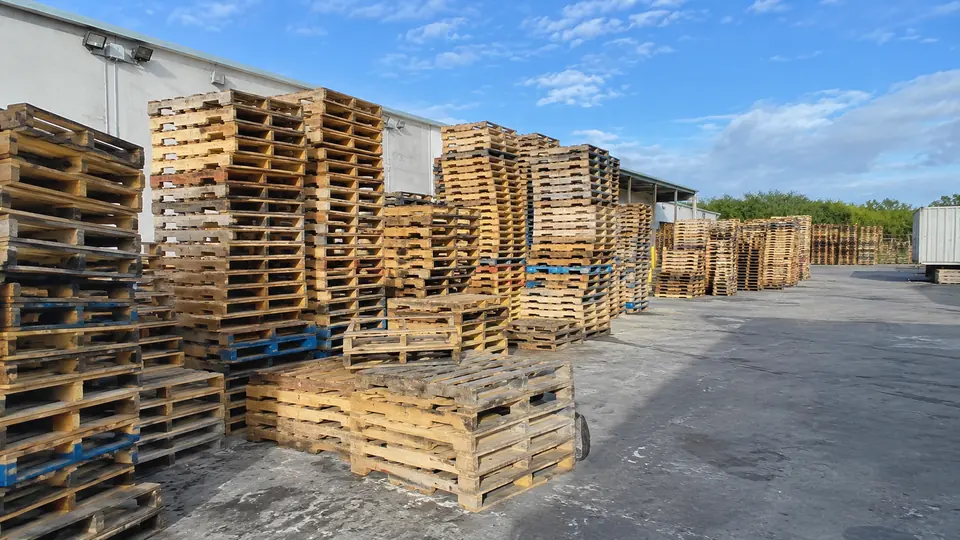
The linear economy is take, make, use, bury. Everybody knows this is bad. Fewer people notice that recycling is only the fourth-best alternative.
The hierarchy, in order of how much good it does
- Refuse / reduce — do not use the material at all. A product that ships without a pallet beats every option below.
- Reuse — the same object, the same job, again. No reprocessing, no energy, no loss of value. This is where almost all the benefit lives.
- Repair — the same object restored to the same job. Nearly as good as reuse.
- Remanufacture — the object's parts become a different object of similar value.
- Recycle — the material loses its form and most of its value, and the reprocessing costs energy.
- Energy recovery — the material is gone, but at least the carbon did some work.
- Landfill — failure.
Recycling is what you do when you have already failed to reuse. It is a consolation prize that the packaging industry has spent thirty years calling a trophy.
Why the pallet is the perfect case study
A pallet is dumb, standardised, repairable, made of one material, and worth very little individually — and yet there are billions of them, and they are collectively responsible for a substantial share of global industrial wood consumption. Every characteristic that makes a pallet boring also makes it ideal for circularity: standardisation means any unit fits any job, single-material construction means repair is trivial, and low individual value means nobody minds if it comes back scuffed.
Four design rules that make anything more circular
Standardise the interface
A pallet works because every forklift in the world agrees on fork spacing. Standard interfaces let objects find new users without modification.
Make it repairable by a stranger
Repair must be possible by someone who did not build the thing, with ordinary tools. Nails win over adhesives for exactly this reason.
Use one material
Mono-material objects separate cleanly at end of life. The only non-wood component in a pallet is the fastener, and a magnet handles that.
Keep it cheap enough to come back
If return freight costs more than the object, the loop breaks. Collapsibility, nesting and backhaul are circularity features, not logistics details.
Designing for disassembly
A longer piece on the single design decision that determines whether an object has one life or ten: how it comes apart.
Read it in the journalEvidence appendix
The arithmetic and the audit trail, in full. Every figure here is rounded down on purpose — a sustainability claim that cannot survive scrutiny is worse than no claim at all.
Where every pound of intake goes
| Stream | Destination | Share of intake mass | Verified by |
|---|---|---|---|
| Reusable whole | Grading and resale | 71% | Unit counts + weighbridge |
| Repairable | Repair benches | 20% | Bench lot records |
| Board harvest | Repair stock for other units | 3% | Internal transfer tickets |
| Remanufacture | Cut-downs, crate components, collar panels, furniture | 2% | Shop records |
| Material grind | Mulch, bedding, path and arena fiber | 3% | Grind batch weights |
| Industrial fuel | Regional boiler — never called recycling | 1% | Outbound scale tickets |
| Metal | Scrap recycler by weight | <1% | Scrap receipts |
| Landfill | — | 0.0% | Quarterly third-party audit since 2016 |
2025 averages by mass. Landfill has no row because it has no tonnage. Part of how that stays true is refusing material we cannot route: painted, stained or pressure-treated lumber, engineered panel, and anything contaminated with food residue, chemicals or hydrocarbons.
The carbon ledger method
| Quantity | Figure | What it covers | Why it is conservative |
|---|---|---|---|
| Avoided emissions per reuse | 1.62 kg CO₂e | Lumber production, milling and assembly of the new-build pallet not manufactured | Excludes avoided landfill methane and avoided transport of new stock |
| Net of our own operations | ≈1.4 kg CO₂e | After grinder, chambers, forklifts and fleet diesel | This is the figure we will put in writing |
| Lumber kept in service | 32 board feet | A standard GMA 48×40 unit | Measured at the low end of observed board thickness |
| Trips added per repair cycle | 5–7 | Useful journeys gained by repairing rather than replacing | Our fleet data shows 6.8 average; we publish 5 |
| Diverted mass | 35 lb per unit per cycle | Weight kept out of landfill | Dry weight at 15% MC, not as-received |
| Material recovery at end of life | 96% | Material streams only | Excludes the 1% that becomes industrial fuel |
Deliberately low. We leave out avoided landfill methane (which would roughly double the headline) and in-wood carbon storage, because both are contested in accounting conventions and a claim that cannot survive an auditor is worse than no claim.
What the fiber line produces
| Product | Screen | Feedstock restriction | Goes to | Minimum |
|---|---|---|---|---|
| Landscape mulch | 1"–2" single grind | Pallet wood only; no C&D, no painted, no engineered panel | Municipal and commercial landscaping, residential bulk | 10 cu yd delivered |
| Playground & path fiber | Double grind, fines screened out | HT stock only | Trails, dog parks, riding arenas | 10 cu yd |
| Animal bedding | Fine grind, kiln run, triple screened | HT stock only, segregated at the grinder | Equine and livestock operations | 10 cu yd |
| Arena fiber | Coarse, de-fined | HT stock only | Riding arenas, paddocks | 20 cu yd |
| Boiler biomass | 3" minus hog fuel, moisture declared | Takes the chemically treated and unknown-origin stream | Regional industrial steam and co-generation | By the ton |
Three magnetic separation passes — one after each size change — plus a hand inspection of the finished windrow before anything is loaded. Grinding does not remove steel; it exposes new steel, which is why the magnets come after every stage rather than only at the start. Iron-oxide colourant available on landscape mulch; natural undyed always available and recommended for vegetable beds.
The reuse hierarchy we actually follow
- 01
Gate & segregation
Weighbridge ticket, then sorting by treatment type and origin before anything is cut. Painted, treated or unknown-origin wood is separated here and never enters the mulch or bedding lines. Contaminated material is refused.
- 02
Breakdown & inspection
Units are broken down and inspected board by board. Deck boards are flexed by hand; anything that creaks, splits at a nail hole or shows end-grain separation comes off.
- 03
Stringer judgement
Cracks longer than a third of the stringer depth, or any crack crossing a notch, send the member to the plug bench or condemn it. This single check decides most of the economics.
- 04
Repair & re-nail
Board swap, companion board, plug, plate, trim. Then every fastener on the unit is driven or replaced — the invisible half of the work, and the part cheap yards skip.
- 05
Moisture & square
Pin meter on random units per lot, reading recorded. Diagonals measured; out-of-square beyond ½" is corrected, not shipped. Above 19% MC the load waits in the dry stack or goes through the kiln.
- 06
Grade, stamp & lot
Grade, build date and lot in soy ink on a stringer face, so a disputed load traces back to the bench and shift that built it. Heat treatment and IPPC marking for anything crossing a border.