Eighteen years, one yard
From two people and a borrowed flatbed on Bratton Lane to eleven acres, six repair benches and a grinder. Nothing about this was a plan.
Work with the yard
Twelve seconds of typing beats a week of phone tag. Everything you send lands with a coordinator who knows the yard inventory.
- Founded
- 2008
- First yard
- 0.4 acres, leased
- Today
- 11 acres, owned
- People
- 41
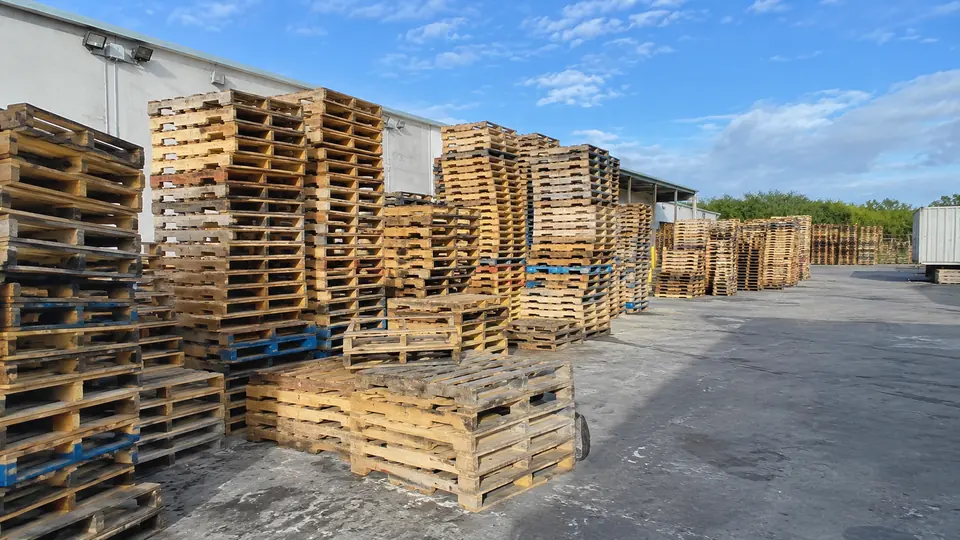
Two people started this in a recession because pallets were the only thing nobody wanted and everybody needed.
2008 — The recession start
Two founders, a borrowed flatbed and a handshake deal to clear a Pflugerville warehouse of 4,000 empties. The warehouse paid them to take the pallets; the next customer paid them for the same pallets. The entire business model fit in that sentence.
2010 — The first bench
A single repair bench under a carport. Output: about 90 units a day, every one inspected by hand. The habit of opening every unit started here and never stopped.
2013 — We stop outsourcing trucks
Two used dry vans and a driver. Outsourced carriers kept treating pallet freight as filler and delivering it late. Owning the trailers turned reliability into something we could promise.
2016 — Zero to landfill
The grinder arrives, and with it the claim we are proudest of. Quarterly third-party audits of diversion tonnage begin the same year and have not lapsed since.
2018 — Heat treatment on site
Our own chambers and a registered ISPM-15 stamp. Export customers stop waiting on third-party kiln schedules; 24-hour turnaround becomes normal.
2020 — The year everything moved
Pallet demand went vertical and supply went sideways. We rationed stock to standing-order customers and told spot buyers the truth about lead times. We lost some business and kept every account that mattered.
2021 — Eleven acres, owned
The lease becomes a purchase. Room for a dry stack, a sort yard, a fiber line and a proper furniture shop.
2023 — The Grain Index
A side project by two people in the office becomes the thing customers mention first. A deterministic grain fingerprint for any pallet spec, free and faintly obsessive.
2026 — Where we are now
41 people, six benches, four metro routes, 2,400 repaired units a week, and still zero tonnes to landfill.
Nobody sets out to become a wood company. You just keep refusing to throw things away until one day you own a grinder.
The people who actually run it
Six benches, four routes, one shop and a sort yard. The names and the jobs, without the stock photography.
People of the yardOperations appendix
What the yard actually does, in numbers, for anyone who would rather read a table than a paragraph about values.
Every service and its lead time
| Service | Lead time | Minimum | Notes |
|---|---|---|---|
| Paid pallet collection, Austin metro | 48 hours, routed | 100 units or 1 trailer | Counted with your team present, signed on the dock |
| Paid collection, Texas Triangle | Weekly, fixed day | 1 trailer | Backhaul lanes to SA, Houston, DFW |
| Yard drop-off | Open during yard hours | 5 units | Saturday mornings are easiest; no appointment |
| Spot load, common footprint | 2–5 business days | 25 units delivered | Subject to grade availability |
| Standing order | Fixed day each week | By agreement | Annual pricing, ≈2 weeks of safety stock held here |
| Repair, toll (your units) | 3–7 business days | 100 units | Your asset numbers and stamps retained |
| Heat treatment & ISPM-15 stamping | Usually 24 hours | By agreement | 4–9 hour cycle; chart trace filed per lot |
| New build to spec | 5–10 business days | 100 units | Tolerance ±⅛" achievable |
| Cut-down to custom footprint | 3–6 business days | 50 units | Tolerance ±¼" |
| Custom crate, one-off | 3–8 business days | 1 | On-site crating available in Austin metro |
| Custom milling, cut list | 3–6 business days | 1 shop hour | Tolerance ±1/16" dimensional |
| Bulk mulch or bedding | 2–5 business days | 10 cu yd | 60 mile delivery radius |
| Sourcing audit | By arrangement | 500 units/week | Half a day on site; free above that volume |
| Same-day, Austin metro | Same day | By arrangement | Premium rate, when a line is about to stop |
All times Central. Lead times are commitments we take seriously and not guarantees against weather, road closure or equipment failure.
Where every pound of incoming wood goes
| Stream | Destination | Share of intake mass | Verified by |
|---|---|---|---|
| Reusable whole | Grading and resale | 71% | Unit counts + weighbridge |
| Repairable | Repair benches | 20% | Bench lot records |
| Board harvest | Repair stock for other units | 3% | Internal transfer tickets |
| Remanufacture | Cut-downs, crate components, collar panels, furniture | 2% | Shop records |
| Material grind | Mulch, bedding, path and arena fiber | 3% | Grind batch weights |
| Industrial fuel | Regional boiler — never called recycling | 1% | Outbound scale tickets |
| Metal | Scrap recycler by weight | <1% | Scrap receipts |
| Landfill | — | 0.0% | Quarterly third-party audit since 2016 |
2025 averages by mass. Landfill has no row because it has no tonnage. Part of how that stays true is refusing material we cannot route: painted, stained or pressure-treated lumber, engineered panel, and anything contaminated with food residue, chemicals or hydrocarbons.
The process between the gate and the trailer
- 01
Gate & segregation
Weighbridge ticket, then sorting by treatment type and origin before anything is cut. Painted, treated or unknown-origin wood is separated here and never enters the mulch or bedding lines. Contaminated material is refused.
- 02
Breakdown & inspection
Units are broken down and inspected board by board. Deck boards are flexed by hand; anything that creaks, splits at a nail hole or shows end-grain separation comes off.
- 03
Stringer judgement
Cracks longer than a third of the stringer depth, or any crack crossing a notch, send the member to the plug bench or condemn it. This single check decides most of the economics.
- 04
Repair & re-nail
Board swap, companion board, plug, plate, trim. Then every fastener on the unit is driven or replaced — the invisible half of the work, and the part cheap yards skip.
- 05
Moisture & square
Pin meter on random units per lot, reading recorded. Diagonals measured; out-of-square beyond ½" is corrected, not shipped. Above 19% MC the load waits in the dry stack or goes through the kiln.
- 06
Grade, stamp & lot
Grade, build date and lot in soy ink on a stringer face, so a disputed load traces back to the bench and shift that built it. Heat treatment and IPPC marking for anything crossing a border.
ISPM-15, in full
- Standard
- ISPM-15, issued under the International Plant Protection Convention. Applies to solid-wood packaging crossing most national borders.
- Heat treatment (HT)
- The core of the thickest member must reach 56 °C and hold it for 30 continuous minutes. Surface temperature is irrelevant; chamber time is not the measure.
- Dielectric (DH)
- An alternative route: 60 °C for one minute throughout the profile. Used for thinner material.
- The mark
- IPPC wheat symbol, two-letter country code (US), the facility's registration number, and the treatment code. On at least two opposite sides, legible without moving the load.
- No certificate exists
- The mark is the certificate — the standard defines no travelling document. We issue a voluntary treatment statement and the chart-recorder trace on request.
- Regulated
- Pallets, crates, cases, skids, bearers, dunnage, blocking and bracing, collars, lids, reels. The dunnage category causes most holds.
- Not regulated
- Plywood, OSB and particleboard; wood 6 mm thick or less; sawdust, shavings and wood wool; wine and spirit barrels.
- After repair
- A stamped unit repaired with untreated wood carries a false mark. It must be re-treated and re-marked. This is the commonest compliance failure in recycled stock.
- What we refuse
- Methyl bromide fumigation, and applying a mark to wood we did not treat — for anybody, at any price, for any deadline.
Standards, testing and defects
What governs this trade, how pallets are actually tested, and the defect list our benches work from. Published because a specification you can check is worth more to us than a lead we captured.
The documents that govern wood packaging
| Document | Issued by | What it governs | Does it bind us? |
|---|---|---|---|
| ISPM-15 | IPPC / FAO | Phytosanitary treatment and marking of solid wood packaging crossing borders | Yes — we are a registered treating facility |
| ISO 6780 | ISO | The six recognised pallet footprints for international trade | Reference; we stock four of the six |
| ISO 8611-1/2/3 | ISO | Test methods, performance requirements and maximum working loads for flat pallets | Methods we quote; we do not issue certifications for recycled stock |
| ISO 18613 | ISO | Repair of flat wooden pallets | Our bench practice aligns with it |
| ASTM D1185 | ASTM | Standard test methods for pallets and related structures | Reference for new-build testing |
| ASTM D6179 | ASTM | Rough handling of unitised loads — incline impact, drop, vibration | Reference for unit-load advice |
| MIL-STD-1660 | US DoD | Design criteria for ammunition unit loads | Only on defence-adjacent work, by request |
| GMA specification | Grocery Manufacturers Association (historic) | The 48×40 footprint, board count and notch geometry | The de facto North American default |
| NWPCA uniform standard | National Wooden Pallet & Container Association | Recycled pallet grading vocabulary | Yes, unless a customer standard supersedes it |
| EPAL technical regulations | European Pallet Association | Licensed manufacture and repair of EUR/EPAL pallets | No — we hold no EPAL licence and say so |
| NHLA rules | National Hardwood Lumber Association | Hardwood lumber grading | Upstream of us; pallet stock sits below the appearance grades |
| ANSI MH1 | ANSI / MHI | Pallets, slip sheets and other material handling definitions | Terminology reference |
We list what does not bind us as deliberately as what does. A supplier vague about which standards it actually holds is the main avoidable risk in this trade.
Test methods and what each one tells you
| Test | What it simulates | What it tells you | Where it matters |
|---|---|---|---|
| Compression, edge-supported | Racking across two rails | Racked working load and deflection | The binding constraint in most warehouses |
| Compression, floor-supported | A load sitting on a flat floor | Static capacity — the biggest and least useful figure | Floor storage only |
| Bending, fork-supported | Lifting on forks | Dynamic capacity | Every movement |
| Incline impact (conbur) | Railcar coupling and hard braking | Whether the unit load stays together | Rail and long-haul road freight |
| Vibration, random and fixed-frequency | Hours of road or rail travel | Fastener loosening and load settlement | Long lanes; this is what kills smooth-shank nails |
| Drop and corner drop | Dock mishandling | Lead board and corner survivability | High-touch distribution |
| Fastener withdrawal | Joint failure under cycling | Service life more than anything else does | Every pallet, every time |
| Creep / sustained load | Months in a rack | Long-term deflection; derate 20–30% | Slow-moving stock, bagged goods |
| Moisture determination | Storage reality | Mould risk and freight weight | All food, chilled and humid-climate work |
We publish tested figures for new builds and representative figures for recycled stock. Every unit of reclaim has an individual history, so an engineering certification on recycled wood would imply a precision nobody can hold.
Defects, severity and what we do about each
| Defect | Where it shows | Severity | What our bench does |
|---|---|---|---|
| Lead board split lengthwise | Outermost top board, either end | Low | Board swap. Commonest repair in the trade; usually means a steep dock leveller |
| Interior deck board crack | Any top or bottom board | Low | Board swap, or companion board where removal would damage the stringer |
| End-grain separation | Board end, at the nail line | Terminal for that board | Board removed and harvested short, or ground. It predicts the next failure |
| Stringer crack, not crossing a notch | Outer or centre stringer | Medium | Plug if over a third of the depth; otherwise re-nail and pass |
| Stringer crack crossing a notch | At a notch corner | High | Plug or condemn. The load path through that stringer is gone |
| Protruding fastener | Anywhere on the deck | Zero tolerance | Driven or replaced before the unit leaves, no exceptions |
| Loose joint / creak | Whole unit | Medium | Full re-nail. A creaking pallet has already failed at the joints |
| Missing chamfer | Bottom board lead edge | Medium | Re-chamfer. Without it every pallet jack fights the unit |
| Out of square beyond ½" | Diagonals | Medium–high | Corrected or condemned. Racking, ASRS and stretch wrap all reject it |
| Moisture above 19% | Whole unit | High | Dry stack or kiln before repair. Mould is then a question of time |
| Blue stain / sapstain | Sapwood faces | Cosmetic, plus odour | Rejected for food and absorbent product; fine elsewhere |
| Bark / wane | Board edges | Low, unless export | Removed where a destination requires debarked wood |
| Mould, visible | Any surface | Reject | Never shipped to a food account; dried and re-graded or ground |
| Paint, stain, coating | Any surface | Reject | Segregated at the gate; industrial fuel stream only |
| Oil or chemical contamination | Any surface | Refused | Refused at the gate and the customer is told why |
| Embedded metal beyond fasteners | Anywhere | High | Removed by hand before any grind; it destroys knives |
Fastener specifications
| Fastener | Typical length | Wire gauge | MIBANT bend angle | Used in |
|---|---|---|---|---|
| Helical, hardened | 2¼"–2½" | 0.099–0.120" | 10–20° | Stringers and blocks, hardwood |
| Helical, standard | 2"–2¼" | 0.099–0.113" | 20–30° | Stringers in softwood |
| Ring shank, hardened | 1¾"–2¼" | 0.099–0.113" | 15–25° | Deck boards, repairs |
| Ring shank, standard | 1½"–2" | 0.092–0.105" | 25–35° | Deck boards, lighter stock |
| Ring shank, galvanised | 1¾"–2¼" | 0.099–0.113" | 20–30° | Outdoor and wash-down service |
| Staple, crown | 1¼"–1¾" | 16–15 gauge | n/a | Collar panels, crate sheathing, lids |
| Smooth shank | any | any | any | Nothing we build |
A lower MIBANT angle means harder, more brittle steel — better withdrawal, more prone to shearing on impact. A higher angle means softer steel that bends rather than snapping, and joints that loosen. Pallet builders pick a window; cheap builders pick a price. 60 to 78 fasteners go into a standard GMA unit.