Grade A vs Grade B, in practice
The price gap between A and B is real, the strength gap mostly is not, and the number of operations paying A prices for B-grade jobs is remarkable. Here is how to tell which you need.
8 min read · November 2025
Start a request on this page
Twelve seconds of typing beats a week of phone tag. Everything you send lands with a coordinator who knows the yard inventory.
- Typical price gap
- 18–30%
- Strength gap
- Usually negligible
- Best saving
- Split-grade loads
- Worst mistake
- Buying grade, not fit
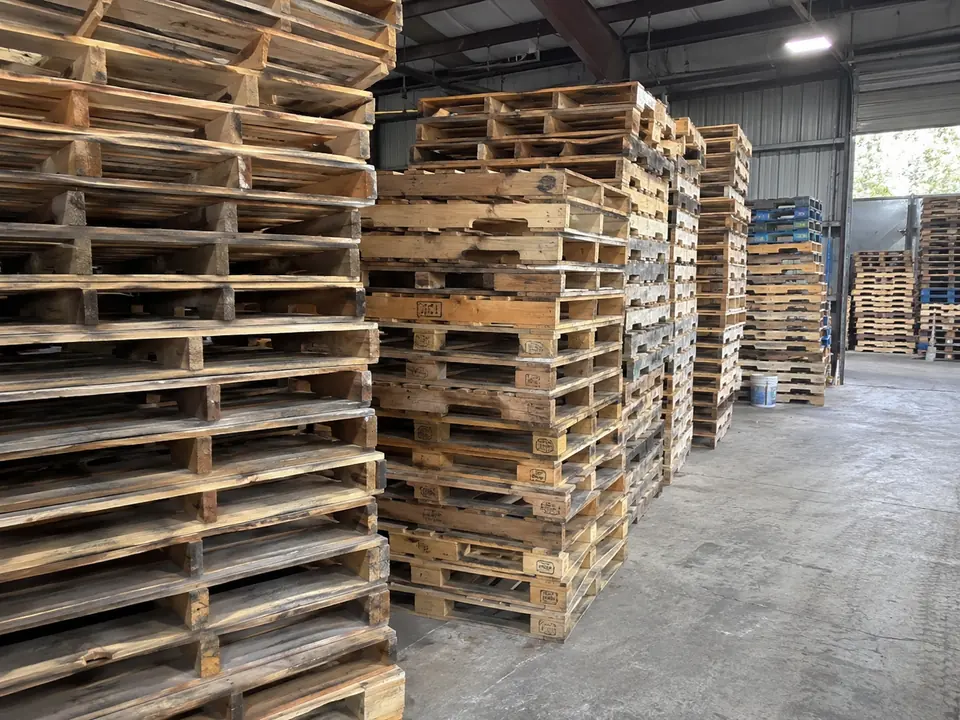
Grade is a description of a pallet's biography. Strength is a question about its structure. Buyers conflate the two constantly, and it costs them money.
What actually differs
| Attribute | Grade A | Grade B | Does it matter? |
|---|---|---|---|
| Original boards | All | Some replaced | Rarely — a replacement board of equal thickness is equal in service |
| Companion boards | None | Permitted | Sometimes — adds thickness, can reduce entry clearance |
| Stringer plugs | None | Permitted | No, if properly double-nailed. Yes, if not. |
| Metal plates | None | Permitted | Yes for automation; plates can foul scanners and conveyors |
| Colour uniformity | High | Mixed | Only if a customer sees the pallet |
| Squareness | Within ¼" | Within ½" | Yes for racking and ASRS; no for floor storage |
| Price | Highest recycled | 18–30% lower | Always |
The four questions that actually decide it
- Does a customer see it? If a consumer or a retail buyer looks at the pallet, buy A. Appearance is a real requirement when it is a requirement.
- Does it go into racking? If yes, squareness matters and A or #1 earns its premium.
- Does automation touch it? If a scanner, conveyor or robot interacts with the pallet geometry, buy A or new. Plates and thickness variation are genuine failure causes.
- Is it one-way? If the pallet leaves and never returns, buy the cheapest grade that will survive the single journey. Paying for cosmetics on a disposable asset is pure waste.
Buy the job, not the grade. Then let the yard pick the grade.
Split-grade loads: the saving nobody asks for
Most operations use one grade for everything because one grade is simpler to order. But a typical distribution operation has a customer-facing flow and an internal flow, and those have completely different requirements. Order A-grade for the outbound face and B-grade for internal movement on the same load, on the same delivery, and the blended cost drops noticeably — in our accounts, typically between twelve and nineteen percent of pallet spend.
Where B genuinely is worse
- Metal-plated stringers can trigger metal detection and foul automated handling. Ask for 'B, no plates' — we grade to it.
- Companion boards add roughly ⅝" of thickness locally, which can matter for powered jack clearance.
- Mixed board colour photographs badly, which matters more than it should for retail display and e-commerce imagery.
- A B-grade unit has, by definition, already been repaired once — so its remaining service life is shorter even when its current strength is equal.
Reference tables
The numbers referred to above, in full, so you do not have to take a sentence's word for them.
Footprints
| Footprint | Inches | Millimetres | Construction | Where it lives | Our stock | Per 53' van |
|---|---|---|---|---|---|---|
| GMA 48×40 | 48" × 40" | 1219 × 1016 | Stringer & block | Grocery, general distribution, retail | Deep | 480–560 |
| 48×48 | 48" × 48" | 1219 × 1219 | Stringer | Drums, reels, wire, square loads | Good | 392–420 |
| 48×45 | 48" × 45" | 1219 × 1143 | Stringer | Automotive, tyre | Good | 420–450 |
| 48×42 | 48" × 42" | 1219 × 1067 | Stringer | Telecom, paint, coatings | Good | 440–480 |
| 42×42 | 42" × 42" | 1067 × 1067 | Stringer | Chemicals, drums, paint | Good | 480–520 |
| 40×48 | 40" × 48" | 1016 × 1219 | Stringer | Beverage, rotated GMA | Good | 480–560 |
| 40×40 | 40" × 40" | 1016 × 1016 | Stringer | Dairy, beverage, bakery | Good | 520–580 |
| 36×36 | 36" × 36" | 914 × 914 | Stringer | Compact, display, light goods | Good | 640–700 |
| 32×30 | 32" × 30" | 813 × 762 | Stringer | Retail display, in-store | Limited | 900+ |
| 30×30 | 30" × 30" | 762 × 762 | Stringer | Light goods, display | Limited | 960+ |
| 48×20 half | 48" × 20" | 1219 × 508 | Stringer | Retail half pallet, promotions | Limited | 1,000+ |
| EPAL 1 | 47.24" × 31.50" | 1200 × 800 | Block, 9 blocks | European trade, retail | To order | 540–600 |
| EPAL 2 / ISO | 47.24" × 39.37" | 1200 × 1000 | Block | Europe, Asia, best container fit | To order | 480–520 |
| Asia square | 43.30" × 43.30" | 1100 × 1100 | Block | Japan, east Asia | To order | 460–500 |
| AU square | 44.88" × 44.88" | 1140 × 1140 | Block | Australia, chemical CP series | To order | 440–480 |
Trailer counts are for stacked, unstrapped loads of sound recycled stock and vary with repair thickness. We confirm the actual count on the bill of lading rather than estimating it. Anything not on this list we cut from reclaim — see custom milling.
Grades
| Grade A | Grade B | #1 premium | #2 economy | Custom cut | |
|---|---|---|---|---|---|
| Original boards | All | Some replaced | All | Several replaced | Mixed |
| Companion boards | None | Permitted | None | Permitted | Permitted |
| Stringer plugs | None | Permitted | None | Permitted | Permitted |
| Metal plates | None | Permitted, disclosed | None | Permitted | Permitted |
| Squareness | Within ¼" | Within ½" | Within ¼" | Within ½" | Within ½" |
| Colour uniformity | High | Mixed | High | Mixed | Mixed, fresh saw ends |
| Protruding fasteners | Zero | Zero | Zero | Zero | Zero |
| Moisture ceiling | 19% (15% on request) | 19% | 19% (15% on request) | 19% | 19% |
| Typical service | Retail-facing, export | Internal, bulk | Automation, racking | One-way, yard storage | Odd footprints |
| Relative price | Highest recycled | −18 to −30% | High | Lowest | ≈⅓ of a new build |
| Remaining life | Longest | Shorter — already repaired once | Longest | Shortest | Varies |
Grade A and #1 overlap: we use #1 for units that needed no repair at all and A for units that are cosmetically uniform. Where a customer holds their own written standard, that document governs and supersedes these names.
Load ratings and deflection
| Construction | Static | Dynamic | Racked (unsupported) | Unit weight |
|---|---|---|---|---|
| Recycled GMA 48×40 stringer, sound | 4,600 lb | 2,800 lb | 1,500 lb | 33–45 lb |
| Recycled 48×40 block, sound | 5,200 lb | 3,000 lb | 1,900 lb | 40–55 lb |
| Recycled 48×40 stringer, repaired (B) | 4,400 lb | 2,650 lb | 1,400 lb | 35–48 lb |
| New southern yellow pine, 5 top boards | 4,200 lb | 2,500 lb | 1,400 lb | 33–38 lb |
| New mixed hardwood block, 7 top boards | 6,000 lb | 3,500 lb | 2,400 lb | 48–58 lb |
| Heavy-duty new build, doubled stringers | 9,000 lb | 5,000 lb | 3,800 lb | 62–78 lb |
| Skid (no bottom deck) | 3,800 lb | 2,200 lb | Not for racking | 24–32 lb |
Representative planning figures for sound stock, not engineering certifications. Racked ratings assume the load spans two rails with nothing under the middle. Derate a further 20–30% for dwell times beyond a few weeks, because wood creeps under sustained load.
- Design ceiling: deflection of span ÷ 100 — about 0.4 inches across a 40-inch unsupported span.
- Orientation: rack a stringer pallet across the wrong axis and the deck boards carry the span instead of the stringers. Capacity can halve.
- Creep: wood deflects progressively under sustained load. A unit measured inside tolerance on day one can exceed it after six months in a rack.
- Stiffness, not strength, is the limit. Mixed hardwood outperforms southern yellow pine in racking by more than their strength figures suggest, because it is substantially stiffer.
- Drive-in racking gives a long unsupported span with no support at the leading edge. Derate hard, use block construction, consider full-perimeter bottom boards.
Moisture and dew point
| Moisture content | What happens | Typical source | Freight weight |
|---|---|---|---|
| 6–12% | Indoor equilibrium. No mould risk. Dimensionally stable. | Kiln dried, stored inside | Lightest |
| 12–19% | Safe working range — our standard ceiling. | Covered dry stack | Normal |
| 19–25% | Mould within days to weeks in warm conditions. | Rain-exposed stacks, green lumber | +5–10% |
| 25–40% | Mould rapid, blue stain likely. | Pallets left in the open through a wet week | +10–20% |
| Above 40% | Saturated. You are paying freight on water. | Standing water, flooded yard | +20%+ |
Mould needs free water. Below roughly 19% the water in wood is chemically bound in the cell walls and spores cannot germinate; above it, they can. Heat treatment kills insects and confers no moisture guarantee; kiln drying reduces moisture and is not a phytosanitary treatment. They are separate claims and conflating them causes both mould claims and border holds.
| Air temperature | Relative humidity | Equilibrium moisture content | Dew point — a pallet colder than this will sweat |
|---|---|---|---|
| 68 °F | 30% | ≈6% | ≈36 °F |
| 68 °F | 40% | ≈7.7% | ≈43 °F |
| 68 °F | 55% | ≈10.2% | ≈51 °F |
| 68 °F | 70% | ≈13.1% | ≈58 °F |
| 68 °F | 85% | ≈18.5% | ≈64 °F |
| 55 °F | 60% | ≈11.3% | ≈41 °F |
| 75 °F | 65% | ≈12.4% | ≈62 °F |
Approximate, for planning. Two separate lessons: wood will eventually equilibrate to whatever air it sits in, and any pallet colder than the dew point of your building's air will condense water on itself and then on your cartons. Acclimatise cold stock indoors for four to twelve hours before loading.
Fasteners
| Fastener | How it holds | Relative withdrawal | Correct for | Wrong for |
|---|---|---|---|---|
| Ring (annular) shank | Rings bite into the fibre; withdrawal must tear wood | 1.8–2.2 | Deck boards, repairs, anywhere a fork strikes | — |
| Helical (screw) shank | Threads itself into the fibre as it drives | 1.7–2.1 | Stringers, blocks, hardwood | — |
| Smooth shank | Friction only; wood shrinks away from it | 1.0 (baseline) | Nothing in a pallet | Every pallet joint |
| Staples | Two thin legs, wide crown, large bearing area | 0.5–0.8 | Collar panels, crate sheathing, lids | Deck and stringer joints |
| Galvanised (any shank) | As above, corrosion resistant | As above | Outdoor and wash-down service | — |
Doubling withdrawal resistance roughly doubles the number of trips a unit survives, for a fastener cost measured in cents. We use ring-shank and helical only, and every unit that has been apart is fully re-nailed. The MIBANT bend-angle test is the industry's rough proxy for nail ductility: too brittle and it snaps on impact, too soft and the joint loosens.
Conversions
| Inches | mm | Millimetres | Inches | Other |
|---|---|---|---|---|
| 20" | 508 | 600 mm | 23.62" | 1 board foot = 144 in³ |
| 24" | 610 | 800 mm | 31.50" | 1 cu yd = 27 cu ft |
| 30" | 762 | 1,000 mm | 39.37" | 1 short ton = 2,000 lb |
| 32" | 813 | 1,100 mm | 43.30" | 1 kg = 2.205 lb |
| 36" | 914 | 1,140 mm | 44.88" | 1" = 25.4 mm exactly |
| 40" | 1,016 | 1,200 mm | 47.24" | 56 °C = 132.8 °F |
| 42" | 1,067 | 1,219 mm | 48.00" | 19% MC = mould threshold |
| 44" | 1,118 | 1,016 mm | 40.00" | 32 bf ≈ one GMA unit |
| 45" | 1,143 | 914 mm | 36.00" | L/100 = deflection ceiling |
| 48" | 1,219 | 762 mm | 30.00" | ≈500 units per 53' van |
Decision trees
Recycled, new, or cut down?
- Does a standard footprint fit your carton pattern with no overhang? If yes → recycled.
- If no: does an oversized footprint exist in reclaim that can be sawn to your size? If yes → cut down, at roughly a third of a new build.
- Does anything automated read the pallet's geometry, or do you need ±⅛"? If yes → new build.
- Is the racked load above about 2,500 lb? If yes → new build, mixed hardwood, block construction.
- Is a documented chain of custody for the wood itself part of an audit? If yes → new build.
- Otherwise → recycled, at the lowest grade that survives the journey.
Buy, own a fleet, or rent from a pool?
- Measure your return rate first. Everything below depends on it and nothing else matters as much.
- Below 50% return → your pallet is packaging. Buy recycled one-way and price it as consumable.
- 50–85% return → the messy middle. Buy recycled on a managed programme, with collection on the same movements.
- Above 85% return, with controlled geography → own a fleet and use toll repair to keep your asset numbers.
- Mandated by a retailer's pool, or shipping to hundreds of points needing identical quality → pool rental, and budget for loss charges.
- Wash-down hygiene is a process requirement → plastic, and we will point you to somebody who sells it.
Stringer or block?
- Does it go into racking where you cannot guarantee orientation? Block.
- Do powered jacks enter from the 48" side? Block.
- Automated storage and retrieval? Block, or new.
- Heavy load sitting for months? Block, mixed hardwood.
- European or ISO-metric footprint? Block by specification, not preference.
- Otherwise → stringer: lighter, cheaper, deeper in recycled stock and easier to repair.
Repair or replace?
- Crack crossing a notch, or more than a third of a stringer's depth? Plug, or condemn.
- Three or more stringer repairs already present? Condemn — that is a pallet held together by optimism.
- Four or more deck boards gone on a low-value footprint? Harvest the boards.
- Above 24% moisture? Dry stack first, then decide.
- Contaminated with oil, chemicals or paint? Out of every reuse stream, permanently.
- Otherwise → repair and re-nail fully, at roughly a third of replacement cost.