What happens to a pallet that finally dies
About four percent of the wood that enters this yard cannot be a pallet, a crate, a collar or a table ever again. Here is exactly where it goes, step by step, and why three magnetic passes are not excessive.
October 24, 2023 · The fiber line · 8 min read · Sustainability
Ask us about anything in this piece
Twelve seconds of typing beats a week of phone tag. Everything you send lands with a coordinator who knows the yard inventory.
- Of intake mass
- ≈4%
- Magnetic passes
- 3
- Finished streams
- 4
- Landfilled
- 0%
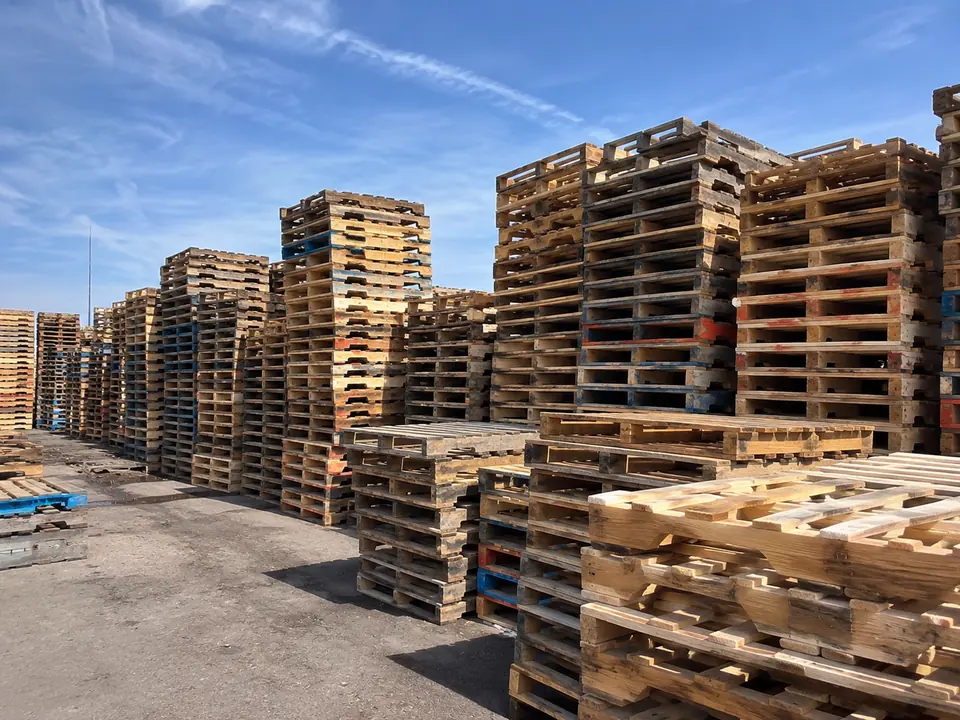
The grinder is the least romantic machine in the yard and the one that makes the zero-landfill claim true.
Before the grinder: the decision
Nothing goes to the grinder until four other options have been refused. Can it be reused whole? Repaired? Harvested for boards? Remanufactured into a cut-down unit, a crate component or a collar panel? Only when all four are no does a unit become feedstock. That order matters environmentally — grinding destroys the form and most of the value, and reprocessing costs energy that reuse does not.
It also matters commercially, which is why we trust it. A repaired pallet is worth several times what its wood is worth as fiber, so the incentive to grind prematurely does not exist.
The line, in order
- Segregation at intake. Treatment type and origin decide the destination before anything is cut. Painted, coated or unknown-origin wood is kept entirely out of mulch, bedding and path fiber and routed to industrial fuel only. Contaminated material is refused at the gate.
- Breakdown. Dead units are reduced so they feed consistently. Oversized members and anything with embedded hardware beyond nails comes out here by hand.
- First grind. A coarse pass through the hammer mill. Output at this stage is hog fuel size and still full of steel.
- Magnetic pass one. The big one — the bulk of nails, plates, staples and banding leaves here and goes to a scrap recycler by weight.
- Screening. Material is sized. Oversize returns for a second grind; fines drop out for bedding and erosion blankets.
- Second grind, where the product needs it. Mulch and bedding get a second pass; path and arena fiber are de-fined instead.
- Magnetic passes two and three. After each size change, because grinding exposes steel that the first pass could not reach.
- Windrow and inspect. Long low piles in the yard, turned periodically, with a hand inspection of the finished material before anything is loaded.
Grinding does not remove nails. It hides them, and then releases them. That is why the magnets come after every size change, not just at the start.
The four finished streams
| Product | Processing | Goes to |
|---|---|---|
| Landscape mulch | Single grind, 1–2 inch, natural or iron-oxide dyed | Municipal and commercial landscaping, residential bulk |
| Playground & path fiber | Double grind, fines screened out, HT stock only | Trails, dog parks, riding arenas |
| Animal bedding | Fine grind, kiln run, HT stock only, triple-screened | Equine and livestock operations east of Austin |
| Boiler biomass | Hog fuel, 3-inch minus, moisture declared | Regional industrial steam and co-generation |
Why pallet mulch behaves differently from tree mulch
Arborist mulch is mostly bark, leaf and green wood: high nitrogen demand, fast decomposition, and a tendency to mat down into a water-shedding crust. Pallet mulch is kiln-dry heartwood and sapwood with the metal removed — it holds colour longer, knits less, and breaks down slowly. In a commercial bed topped once a year rather than three times, that is precisely the behaviour you want, and it is why landscape contractors who have tried both tend to stay.
Reference tables
The numbers referred to above, in full, so you do not have to take a sentence's word for them.
Footprints
| Footprint | Inches | Millimetres | Construction | Where it lives | Our stock | Per 53' van |
|---|---|---|---|---|---|---|
| GMA 48×40 | 48" × 40" | 1219 × 1016 | Stringer & block | Grocery, general distribution, retail | Deep | 480–560 |
| 48×48 | 48" × 48" | 1219 × 1219 | Stringer | Drums, reels, wire, square loads | Good | 392–420 |
| 48×45 | 48" × 45" | 1219 × 1143 | Stringer | Automotive, tyre | Good | 420–450 |
| 48×42 | 48" × 42" | 1219 × 1067 | Stringer | Telecom, paint, coatings | Good | 440–480 |
| 42×42 | 42" × 42" | 1067 × 1067 | Stringer | Chemicals, drums, paint | Good | 480–520 |
| 40×48 | 40" × 48" | 1016 × 1219 | Stringer | Beverage, rotated GMA | Good | 480–560 |
| 40×40 | 40" × 40" | 1016 × 1016 | Stringer | Dairy, beverage, bakery | Good | 520–580 |
| 36×36 | 36" × 36" | 914 × 914 | Stringer | Compact, display, light goods | Good | 640–700 |
| 32×30 | 32" × 30" | 813 × 762 | Stringer | Retail display, in-store | Limited | 900+ |
| 30×30 | 30" × 30" | 762 × 762 | Stringer | Light goods, display | Limited | 960+ |
| 48×20 half | 48" × 20" | 1219 × 508 | Stringer | Retail half pallet, promotions | Limited | 1,000+ |
| EPAL 1 | 47.24" × 31.50" | 1200 × 800 | Block, 9 blocks | European trade, retail | To order | 540–600 |
| EPAL 2 / ISO | 47.24" × 39.37" | 1200 × 1000 | Block | Europe, Asia, best container fit | To order | 480–520 |
| Asia square | 43.30" × 43.30" | 1100 × 1100 | Block | Japan, east Asia | To order | 460–500 |
| AU square | 44.88" × 44.88" | 1140 × 1140 | Block | Australia, chemical CP series | To order | 440–480 |
Trailer counts are for stacked, unstrapped loads of sound recycled stock and vary with repair thickness. We confirm the actual count on the bill of lading rather than estimating it. Anything not on this list we cut from reclaim — see custom milling.
Grades
| Grade A | Grade B | #1 premium | #2 economy | Custom cut | |
|---|---|---|---|---|---|
| Original boards | All | Some replaced | All | Several replaced | Mixed |
| Companion boards | None | Permitted | None | Permitted | Permitted |
| Stringer plugs | None | Permitted | None | Permitted | Permitted |
| Metal plates | None | Permitted, disclosed | None | Permitted | Permitted |
| Squareness | Within ¼" | Within ½" | Within ¼" | Within ½" | Within ½" |
| Colour uniformity | High | Mixed | High | Mixed | Mixed, fresh saw ends |
| Protruding fasteners | Zero | Zero | Zero | Zero | Zero |
| Moisture ceiling | 19% (15% on request) | 19% | 19% (15% on request) | 19% | 19% |
| Typical service | Retail-facing, export | Internal, bulk | Automation, racking | One-way, yard storage | Odd footprints |
| Relative price | Highest recycled | −18 to −30% | High | Lowest | ≈⅓ of a new build |
| Remaining life | Longest | Shorter — already repaired once | Longest | Shortest | Varies |
Grade A and #1 overlap: we use #1 for units that needed no repair at all and A for units that are cosmetically uniform. Where a customer holds their own written standard, that document governs and supersedes these names.
Load ratings and deflection
| Construction | Static | Dynamic | Racked (unsupported) | Unit weight |
|---|---|---|---|---|
| Recycled GMA 48×40 stringer, sound | 4,600 lb | 2,800 lb | 1,500 lb | 33–45 lb |
| Recycled 48×40 block, sound | 5,200 lb | 3,000 lb | 1,900 lb | 40–55 lb |
| Recycled 48×40 stringer, repaired (B) | 4,400 lb | 2,650 lb | 1,400 lb | 35–48 lb |
| New southern yellow pine, 5 top boards | 4,200 lb | 2,500 lb | 1,400 lb | 33–38 lb |
| New mixed hardwood block, 7 top boards | 6,000 lb | 3,500 lb | 2,400 lb | 48–58 lb |
| Heavy-duty new build, doubled stringers | 9,000 lb | 5,000 lb | 3,800 lb | 62–78 lb |
| Skid (no bottom deck) | 3,800 lb | 2,200 lb | Not for racking | 24–32 lb |
Representative planning figures for sound stock, not engineering certifications. Racked ratings assume the load spans two rails with nothing under the middle. Derate a further 20–30% for dwell times beyond a few weeks, because wood creeps under sustained load.
- Design ceiling: deflection of span ÷ 100 — about 0.4 inches across a 40-inch unsupported span.
- Orientation: rack a stringer pallet across the wrong axis and the deck boards carry the span instead of the stringers. Capacity can halve.
- Creep: wood deflects progressively under sustained load. A unit measured inside tolerance on day one can exceed it after six months in a rack.
- Stiffness, not strength, is the limit. Mixed hardwood outperforms southern yellow pine in racking by more than their strength figures suggest, because it is substantially stiffer.
- Drive-in racking gives a long unsupported span with no support at the leading edge. Derate hard, use block construction, consider full-perimeter bottom boards.
Moisture and dew point
| Moisture content | What happens | Typical source | Freight weight |
|---|---|---|---|
| 6–12% | Indoor equilibrium. No mould risk. Dimensionally stable. | Kiln dried, stored inside | Lightest |
| 12–19% | Safe working range — our standard ceiling. | Covered dry stack | Normal |
| 19–25% | Mould within days to weeks in warm conditions. | Rain-exposed stacks, green lumber | +5–10% |
| 25–40% | Mould rapid, blue stain likely. | Pallets left in the open through a wet week | +10–20% |
| Above 40% | Saturated. You are paying freight on water. | Standing water, flooded yard | +20%+ |
Mould needs free water. Below roughly 19% the water in wood is chemically bound in the cell walls and spores cannot germinate; above it, they can. Heat treatment kills insects and confers no moisture guarantee; kiln drying reduces moisture and is not a phytosanitary treatment. They are separate claims and conflating them causes both mould claims and border holds.
| Air temperature | Relative humidity | Equilibrium moisture content | Dew point — a pallet colder than this will sweat |
|---|---|---|---|
| 68 °F | 30% | ≈6% | ≈36 °F |
| 68 °F | 40% | ≈7.7% | ≈43 °F |
| 68 °F | 55% | ≈10.2% | ≈51 °F |
| 68 °F | 70% | ≈13.1% | ≈58 °F |
| 68 °F | 85% | ≈18.5% | ≈64 °F |
| 55 °F | 60% | ≈11.3% | ≈41 °F |
| 75 °F | 65% | ≈12.4% | ≈62 °F |
Approximate, for planning. Two separate lessons: wood will eventually equilibrate to whatever air it sits in, and any pallet colder than the dew point of your building's air will condense water on itself and then on your cartons. Acclimatise cold stock indoors for four to twelve hours before loading.
Fasteners
| Fastener | How it holds | Relative withdrawal | Correct for | Wrong for |
|---|---|---|---|---|
| Ring (annular) shank | Rings bite into the fibre; withdrawal must tear wood | 1.8–2.2 | Deck boards, repairs, anywhere a fork strikes | — |
| Helical (screw) shank | Threads itself into the fibre as it drives | 1.7–2.1 | Stringers, blocks, hardwood | — |
| Smooth shank | Friction only; wood shrinks away from it | 1.0 (baseline) | Nothing in a pallet | Every pallet joint |
| Staples | Two thin legs, wide crown, large bearing area | 0.5–0.8 | Collar panels, crate sheathing, lids | Deck and stringer joints |
| Galvanised (any shank) | As above, corrosion resistant | As above | Outdoor and wash-down service | — |
Doubling withdrawal resistance roughly doubles the number of trips a unit survives, for a fastener cost measured in cents. We use ring-shank and helical only, and every unit that has been apart is fully re-nailed. The MIBANT bend-angle test is the industry's rough proxy for nail ductility: too brittle and it snaps on impact, too soft and the joint loosens.
Conversions
| Inches | mm | Millimetres | Inches | Other |
|---|---|---|---|---|
| 20" | 508 | 600 mm | 23.62" | 1 board foot = 144 in³ |
| 24" | 610 | 800 mm | 31.50" | 1 cu yd = 27 cu ft |
| 30" | 762 | 1,000 mm | 39.37" | 1 short ton = 2,000 lb |
| 32" | 813 | 1,100 mm | 43.30" | 1 kg = 2.205 lb |
| 36" | 914 | 1,140 mm | 44.88" | 1" = 25.4 mm exactly |
| 40" | 1,016 | 1,200 mm | 47.24" | 56 °C = 132.8 °F |
| 42" | 1,067 | 1,219 mm | 48.00" | 19% MC = mould threshold |
| 44" | 1,118 | 1,016 mm | 40.00" | 32 bf ≈ one GMA unit |
| 45" | 1,143 | 914 mm | 36.00" | L/100 = deflection ceiling |
| 48" | 1,219 | 762 mm | 30.00" | ≈500 units per 53' van |
Decision trees
Recycled, new, or cut down?
- Does a standard footprint fit your carton pattern with no overhang? If yes → recycled.
- If no: does an oversized footprint exist in reclaim that can be sawn to your size? If yes → cut down, at roughly a third of a new build.
- Does anything automated read the pallet's geometry, or do you need ±⅛"? If yes → new build.
- Is the racked load above about 2,500 lb? If yes → new build, mixed hardwood, block construction.
- Is a documented chain of custody for the wood itself part of an audit? If yes → new build.
- Otherwise → recycled, at the lowest grade that survives the journey.
Buy, own a fleet, or rent from a pool?
- Measure your return rate first. Everything below depends on it and nothing else matters as much.
- Below 50% return → your pallet is packaging. Buy recycled one-way and price it as consumable.
- 50–85% return → the messy middle. Buy recycled on a managed programme, with collection on the same movements.
- Above 85% return, with controlled geography → own a fleet and use toll repair to keep your asset numbers.
- Mandated by a retailer's pool, or shipping to hundreds of points needing identical quality → pool rental, and budget for loss charges.
- Wash-down hygiene is a process requirement → plastic, and we will point you to somebody who sells it.
Stringer or block?
- Does it go into racking where you cannot guarantee orientation? Block.
- Do powered jacks enter from the 48" side? Block.
- Automated storage and retrieval? Block, or new.
- Heavy load sitting for months? Block, mixed hardwood.
- European or ISO-metric footprint? Block by specification, not preference.
- Otherwise → stringer: lighter, cheaper, deeper in recycled stock and easier to repair.
Repair or replace?
- Crack crossing a notch, or more than a third of a stringer's depth? Plug, or condemn.
- Three or more stringer repairs already present? Condemn — that is a pallet held together by optimism.
- Four or more deck boards gone on a low-value footprint? Harvest the boards.
- Above 24% moisture? Dry stack first, then decide.
- Contaminated with oil, chemicals or paint? Out of every reuse stream, permanently.
- Otherwise → repair and re-nail fully, at roughly a third of replacement cost.